Built on the Training Ground

The transfer market is the quickest way to change a squad.
Training is how you change the players already in it.
That difference matters.
A new signing can solve a problem immediately. A development plan asks whether the answer might already be inside your club: the young midfielder who needs experience, the winger with pace but an unreliable first touch, or the experienced centre-back who no longer needs more work—he needs fewer tired legs.
In For The Title, training is not a background switch marked “improve squad”.
It is a daily football decision.
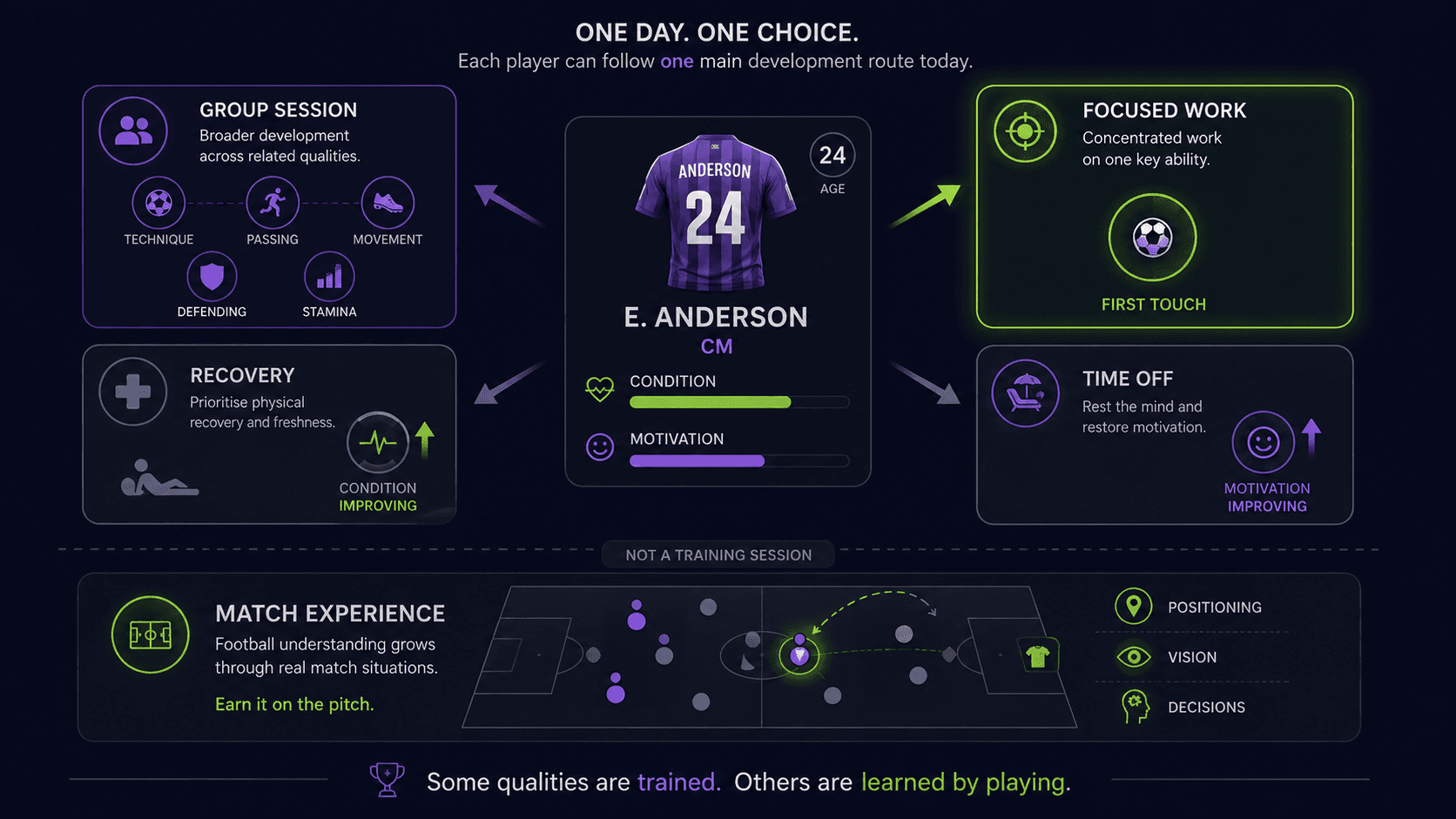
Every game day, you may decide what each player needs most. Some need technical work. Some need physical development. Some need recovery. Some need time away from the routine.
And some need to play.
Monday morning at the training ground
Imagine the squad returning after a difficult away match.
Your starting right-back played the full game and finished it looking rather less enthusiastic about overlapping than he did.
A young central midfielder stayed on the bench again. He is technically capable, but his positioning and decisions still look uncertain when matches become quicker.
Your reserve winger is fresh, motivated and desperate for an opportunity. He can accelerate away from defenders, but his first touch sometimes accelerates away from him too.
All three are available for training.
All three need something different.
That is the foundation of the system.
Each player follows one current assignment when the club’s daily training cycle is carried out. A player working on technique is not recovering that day. A player taking time off is not directly developing an ability. A player focusing on one specialist quality is not spreading the same attention across the rest of his game.
You are always choosing a priority.
Training the player in front of you
A good development plan begins with a football question.
What are you trying to help this player become?
That question is more useful than simply asking which ability has the lowest number.
A quick winger does not necessarily need every weakness corrected. He may become more valuable by improving the qualities that already make him dangerous.
A technically secure midfielder may not need more decoration on the ball. He may need the stamina to remain involved late in matches.
A centre-back who reads danger well may never become quick enough to defend huge spaces behind an aggressive press. You could spend months chasing that weakness, or build a defensive shape that values what he already does well.
Training lets you develop players towards a purpose.
That purpose comes from your squad, your tactic and the role you imagine for them.
What can be trained directly
FTT players are built from detailed football abilities covering control, execution, physical qualities and football understanding.
Technical, competitive and physical qualities can be developed directly through training sessions.
That includes areas such as first touch, passing, crossing, tackling, dribbling, finishing, strength, stamina, pace and reaction.
The training ground is where repetition matters.
A winger can work on receiving the ball cleanly before attacking his defender. A midfielder can spend time improving distribution. A centre-back can focus on tackling, heading or balance. A striker can work on the actions that happen before and during the finish.
These are visible football objectives.
You are not assigning abstract development points. You are deciding what kind of work the player is doing and which parts of his game deserve attention.
Some qualities must be learned in matches
Not every part of a footballer is developed through a menu of drills.
Mental skills and reading the game through skills like positioning, vision, anticipation, teamwork, composure and decision-making are intended to grow mainly through match experience.
That creates an important separation between training and playing.
You can practise an action.
You learn the match by playing the match.
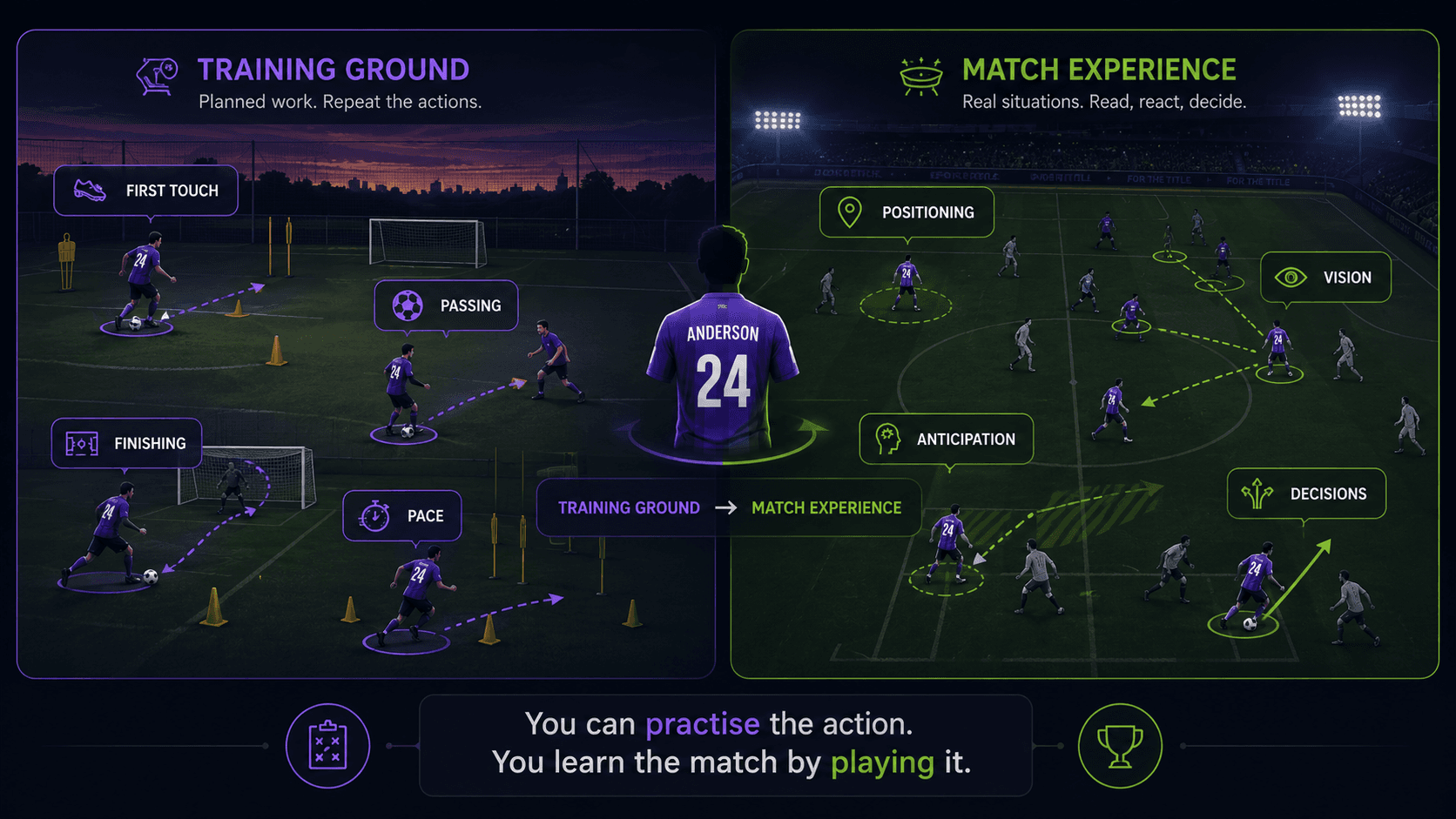
A young midfielder may improve his first touch and passing during the week, but that does not automatically teach him when to release the ball under pressure, where to stand when possession is lost or how to recognize space before it closes.
Those lessons come from involvement.
They come from receiving the ball with an opponent behind him. From following a runner and realizing too late that somebody else should have taken over. From making the correct pass, the wrong pass and the safe pass when the team desperately needed the brave one.
This gives match minutes a developmental purpose beyond the immediate result.
It also creates a real management problem.
Do you select the reliable senior player because the next match matters?
Do you give the younger player minutes because his future matters?
Can you use rotation, substitute appearances or lower-pressure situations to provide experience without asking him to carry too much responsibility too soon?
There is no single correct answer.
Broad sessions, focused work and club ideas
FTT provides several ways to organize development.
Standard group sessions develop related areas together. Footwork can support control and creativity in possession. Resilience focuses on defensive reliability and presence. Finishing develops the actions involved in creating and completing chances. Endurance works on sustained physical output and movement.
Other standard programmes support distribution, balance and reliable execution.
These sessions are useful when a player needs broader development across several connected qualities.
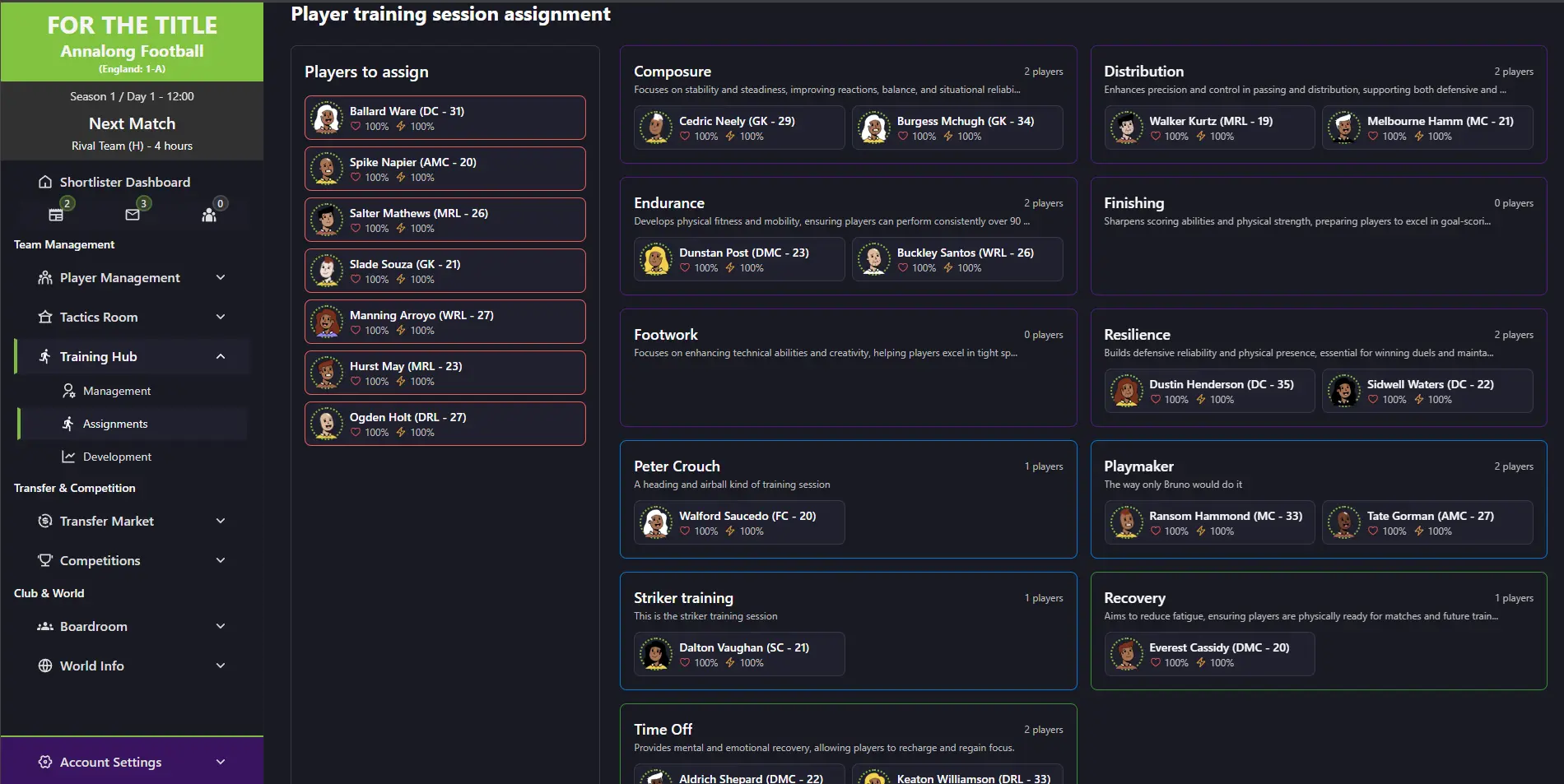
Focused sessions take the opposite approach.
They concentrate the day’s work on one directly trainable ability. A striker may focus on finishing. A defender may work specifically on passing. A winger may concentrate on first touch.
That does not make focused training a free shortcut.
Specialization always has an opportunity cost. The more attention you place on one area, the less broadly you develop the rest of the profile that day.
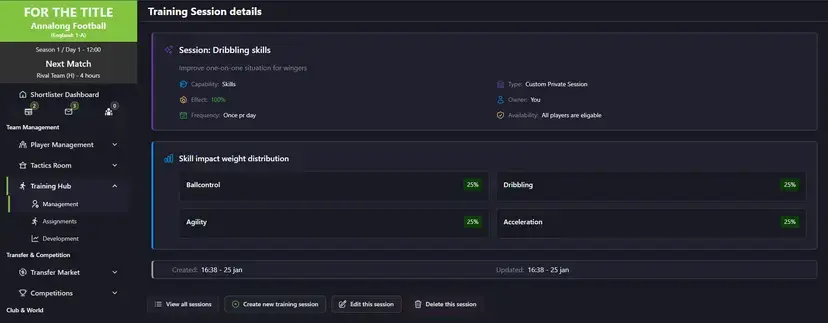
Managers can also create club-specific sessions built around a football role.
A direct-winger programme might combine acceleration, dribbling, crossing and first touch.
A ball-playing defender programme might focus on passing, technique, shielding and balance.
A penalty-area striker programme might combine finishing, shooting, first touch, strength and reaction.
These are not hidden recipes for the perfect player.
They are football plans.
The right combination depends on what the player already has, what your team asks him to do and which weaknesses you are willing to accept.
Signing every promising midfielder is technically a squad-building plan. Training all of them for the same role is where the explanation becomes slightly harder.
The same session does not create the same player
Two players can follow the same programme and respond differently.
Age matters.
Motivation matters.
Current ability matters.
The player’s individual development profile matters.
Younger players generally have more development ahead of them, but youth is not proof of elite potential. An older player may improve more slowly, but focused work can still make him more useful in a specific role.
A developing player may respond quickly in one area and struggle in another. A technically gifted player may find further improvement difficult because he is already operating at a high level.
The closer a footballer gets to the top of an ability, the harder it becomes to make another meaningful gain.
That means development should not be judged from one day or one session.
Managers need to look for trends.
Is the player improving consistently?
Is the programme making him more useful in matches?
Has a former weakness become reliable enough?
Would continued work produce real value, or is the player better served by maintaining what he has?
Training gives you evidence.
It does not reveal the player’s final form in advance.
Motivation is part of the plan
A demanding programme is only useful when the player is ready to respond to it.
Motivation affects how strongly a player responds to normal training. A motivated footballer is more receptive to the work. A player whose motivation has dropped may train without gaining as much from the same session.
This makes motivation more than a mood icon beside the player’s name.
It becomes part of your development decision.
Has the player been following an intensive programme for too long?
Is he receiving any meaningful match opportunity?
Are you training him for a role he has little chance of playing?
Would another demanding session help, or would one day away from the routine improve the work that follows?
Sometimes the best way to improve tomorrow’s training is to stop training today.
Recovery and time off are not the same choice
Recovery and time off both step away from direct ability development, but they serve different purposes.
Recovery prioritizes the body.
It is useful after demanding matches, during congested periods or when a player’s condition needs attention before the next fixture.
Time off prioritizes the mind.
It helps restore motivation and freshness when a player has become worn down by the routine.
Both provide some benefit to condition and motivation, but their emphasis is different.
This creates another trade-off.
Your regular starter may benefit more from recovery than another physical session. Your fit but demotivated squad player may need time off rather than more drills. A young reserve with good condition and high motivation may be ready for sustained development work.
The correct choice depends on the player’s situation.
More training is not always better management.
The young midfielder’s week
Return to the young central midfielder from Monday morning.
He already has useful technique and passing. His problem is not that he cannot play the ball. His problem is understanding when, where and why.
You assign him to a programme that develops first touch, passing and stamina.
That helps him execute the role.
Then you give him minutes from the bench in the next match.
That gives him situations to read.
He enters while the team is protecting a narrow lead. The tempo is higher than it appears from the touchline. Space disappears quickly. One careless pass invites pressure.
He makes a few safe decisions, one excellent forward pass and one run that leaves more room behind him than you would have preferred.
That appearance is part of his development.
Afterwards, you review the wider evidence: his training work, his match involvement, his condition and his motivation.
Then you adjust the plan.
Perhaps he needs another substitute appearance. Perhaps the next match is too important. Perhaps his stamina programme is working, but his role in the team needs to be simpler.
Development becomes a conversation between the training ground and the pitch.
Managing the whole squad
Training is not only about maximizing the progress of individual players.
You are also preparing the future shape of the squad.
Which older starter needs a replacement?
Which young player is close enough to contribute?
Are you developing several players for the same role while ignoring another position?
Can training reduce the need for a transfer?
Should a versatile player become more specialized, or should you preserve his ability to cover several areas?
The answer may change during the season.
A promotion challenge creates different priorities from a rebuilding year. A congested run of fixtures may shift the focus towards recovery. An injury can turn a long-term project into an immediate first-team option.
The training plan should move with the football situation.
Use the evidence, not a universal answer
FTT records development so you can learn from your own squad.
You can review which abilities have changed, how players have responded, which sessions have been used and whether condition or motivation has suffered during a demanding period.
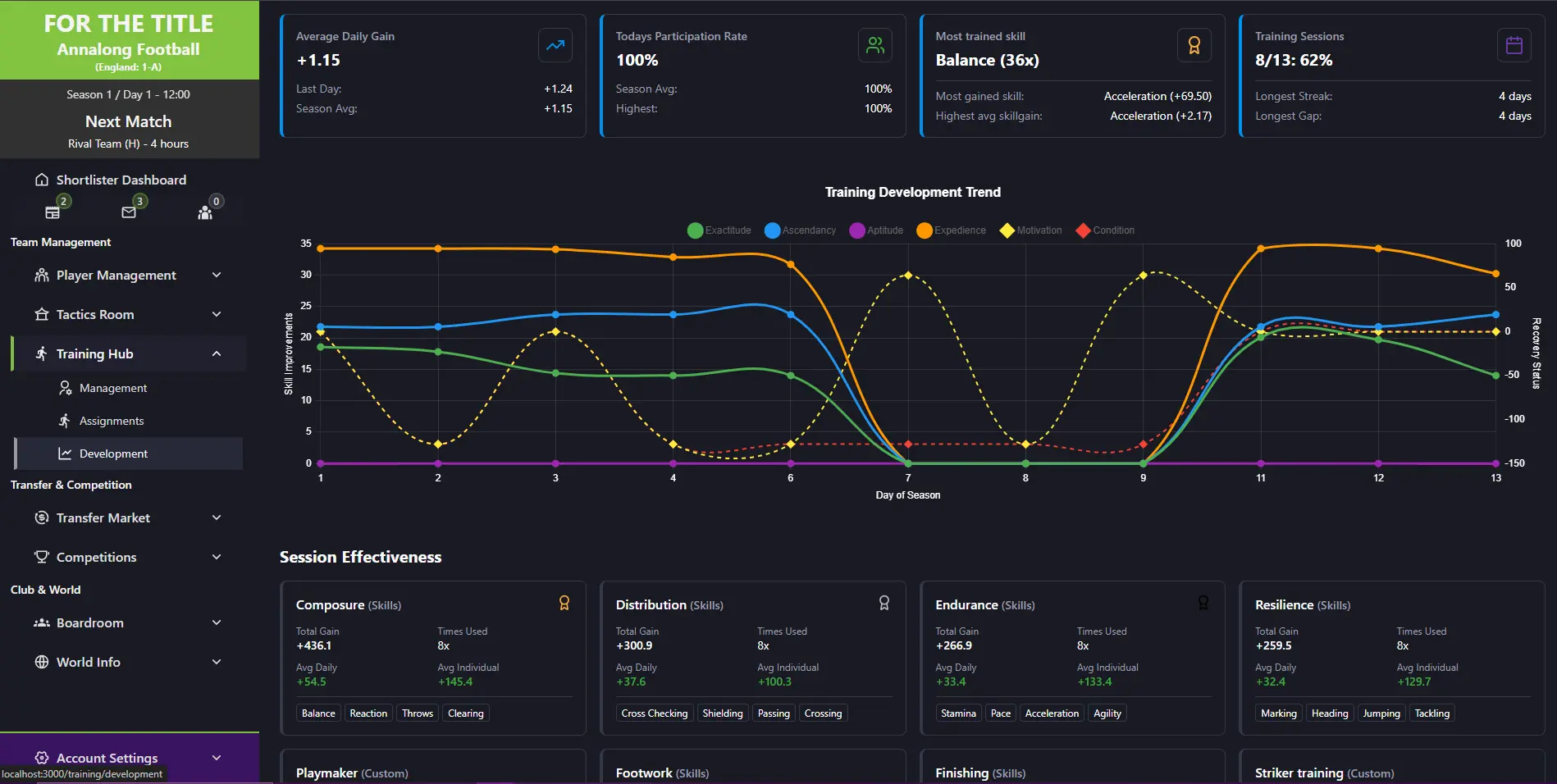
That information is there to support your judgement.
It is not intended to produce a global ranking showing that one session is always best.
A programme may appear successful because it was used with several young, motivated players. Another may show smaller gains because it focused on established footballers already close to their strongest level.
Context matters.
Look at the player, the role and the objective.
Ask whether the training is changing what happens on the pitch.
What we are still developing
The core foundations for daily sessions, focused work, custom programmes, recovery, time off and development history are already represented in FTT.
We are still connecting and refining some of the wider systems around them.
Match-related development has a strong foundation in the data and player-history views, but the full live process for turning and tuning match experience into mental development is still being completed and balanced.
Staff, specialist coaches, facilities and detailed workload-related injury risk are not mature systems in the current version.
We will talk about those areas when they create real managerial decisions rather than simply appearing as another tab.
The player you decide to build
Training in FTT is not about discovering one perfect schedule.
It is about deciding what matters today without losing sight of the player you want tomorrow.
You can develop technique.
You can build physical qualities.
You can create specialist programmes.
You can protect condition, restore motivation and provide match experience.
What you cannot do is guarantee that every player follows the same path.
The same training plan will not produce the same footballer twice.
FTT gives you the training ground, the match opportunities and the evidence.
You decide what kind of player your club is trying to build. But you can also keep it simple. Sometimes keeping it simple is what matches your manageral style.