Climbing the Pyramid: Divisions, Promotion and Relegation in FTT

A football season gives every club something to chase.
For some, that means winning the top division. For others, it means earning promotion, surviving at a new level or rebuilding after relegation. The same league table can hold several different stories, and most of them become more interesting once the pressure arrives.
For The Title is built around a five-level national league pyramid.
Every country follows the same core structure: divisions become wider further down the pyramid, successful clubs move upward, and struggling clubs can fall into the level below.
Your club’s place is not permanent.
You have to earn the right to climb and do enough to stay there.
Five levels, one national pyramid
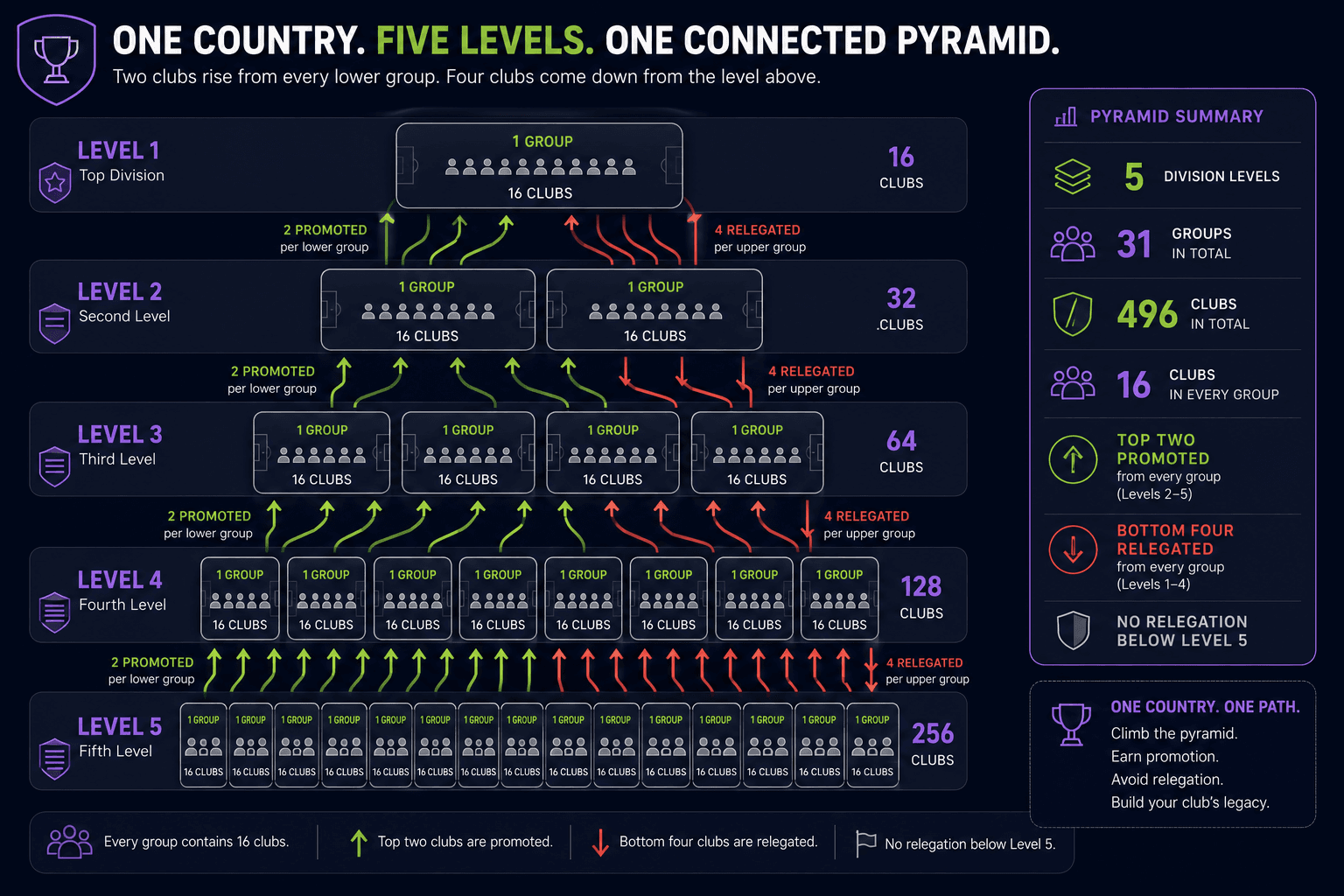
Each fully populated country contains five division levels.
At the top is a single Level 1 division. Below it, the number of groups doubles at every step:
1 → 2 → 4 → 8 → 16
That gives each country:
- 1 division at Level 1
- 2 divisions at Level 2
- 4 divisions at Level 3
- 8 divisions at Level 4
- 16 divisions at Level 5
In total, a fully populated country contains 31 divisions or groups.
Every division or group contains 16 clubs, giving the full national structure 496 clubs.
The shape is deliberately wider at the bottom than at the top. More clubs can begin in the lower levels, while fewer places are available as you move towards the strongest division in the country.
The higher you climb, the narrower the path becomes.
Football has always been generous like that.
Why the pyramid gets wider
The doubling structure gives every level a clear relationship with the one above it.
Two divisions at a lower level feed into one group at the next level:
- Two Level 2 divisions connect to Level 1
- Four Level 3 divisions connect to the two Level 2 divisions
- Eight Level 4 divisions connect to the four Level 3 divisions
- Sixteen Level 5 divisions connect to the eight Level 4 divisions
This creates a balanced route through the pyramid.
Each lower divisions promotes two clubs, while the divisions above relegates four clubs. Because two lower divisions feed one higher group, their promoted clubs replace the four teams coming down.
For example, Level 1 relegates four clubs. The two Level 2 divisions beneath it each promote two clubs, providing four promoted teams in total.
The same balance continues further down.
The two Level 2 divisions relegate eight clubs between them. The four Level 3 divisions each promote two, also producing eight clubs.
The numbers grow, but the relationship stays easy to follow.
Two divisions below. Two promoted from each. Four relegated from above.
Promotion: earning the next challenge
Promotion is the reward for finishing in one of the top two places in your group.
At Levels 2 to 5, each group promotes two clubs. That gives managers a clear target without making every season a winner-takes-all race.
Finishing first still matters. So does finishing second.
Both clubs have earned the right to move upward.
Promotion changes the situation around your team. The next level brings a different group of opponents and a smaller part of the pyramid. A squad that controlled matches at one level may find less space against stronger teams. A pressing approach that overwhelmed opponents may demand more from your players when the tempo rises.
That creates decisions before and after the promotion is secured.
Do you strengthen during the promotion race, knowing the squad may need to compete at a higher level next season? Do you trust the players who brought you up? Do you prioritise experience, development or squad depth?
There is no single correct solution.
A patient club may keep most of its squad together and continue developing it. Another manager may decide that promotion is the right moment to reshape the team.
The important part is that moving up does not complete the project.
It changes the project.
Relegation: pressure at the other end
Relegation keeps the lower end of each division meaningful.
Level 1 to Level 4 each relegate four clubs per division. Level 5 is the bottom of the current structure, so it does not relegate clubs further.
That means:
- Level 1 relegates 4 clubs
- Level 2 relegates 8 clubs across its 2 groups
- Level 3 relegates 16 clubs across its 4 groups
- Level 4 relegates 32 clubs across its 8 groups
- Level 5 relegates none
A relegation fight asks different questions from a promotion race.
You may need immediate results, but short-term decisions can affect the squad you are building. Experienced players may help stabilise the team, while younger players may need time and confidence. A more ambitious shape could create the chances you need, but leave space when possession is lost.
Survival is not only about becoming more defensive.
It is about finding the balance your squad can carry out.
Sometimes a club will stay up because it improves at the right moment. Sometimes it will survive because another team has an even worse month. Football rarely asks whether the points were elegant.
Relegation is not the end of a club’s story either.
It may force a rebuild, change recruitment priorities or give developing players a bigger role. The challenge then becomes turning a difficult season into a route back upward.
Sixteen clubs in every divisions
Every division or group contains 16 clubs.
That number keeps competitions large enough to create different races across the table while remaining easy to understand. Some clubs will be chasing promotion, some will be trying to move into the top half, and others will be fighting to avoid the bottom four.
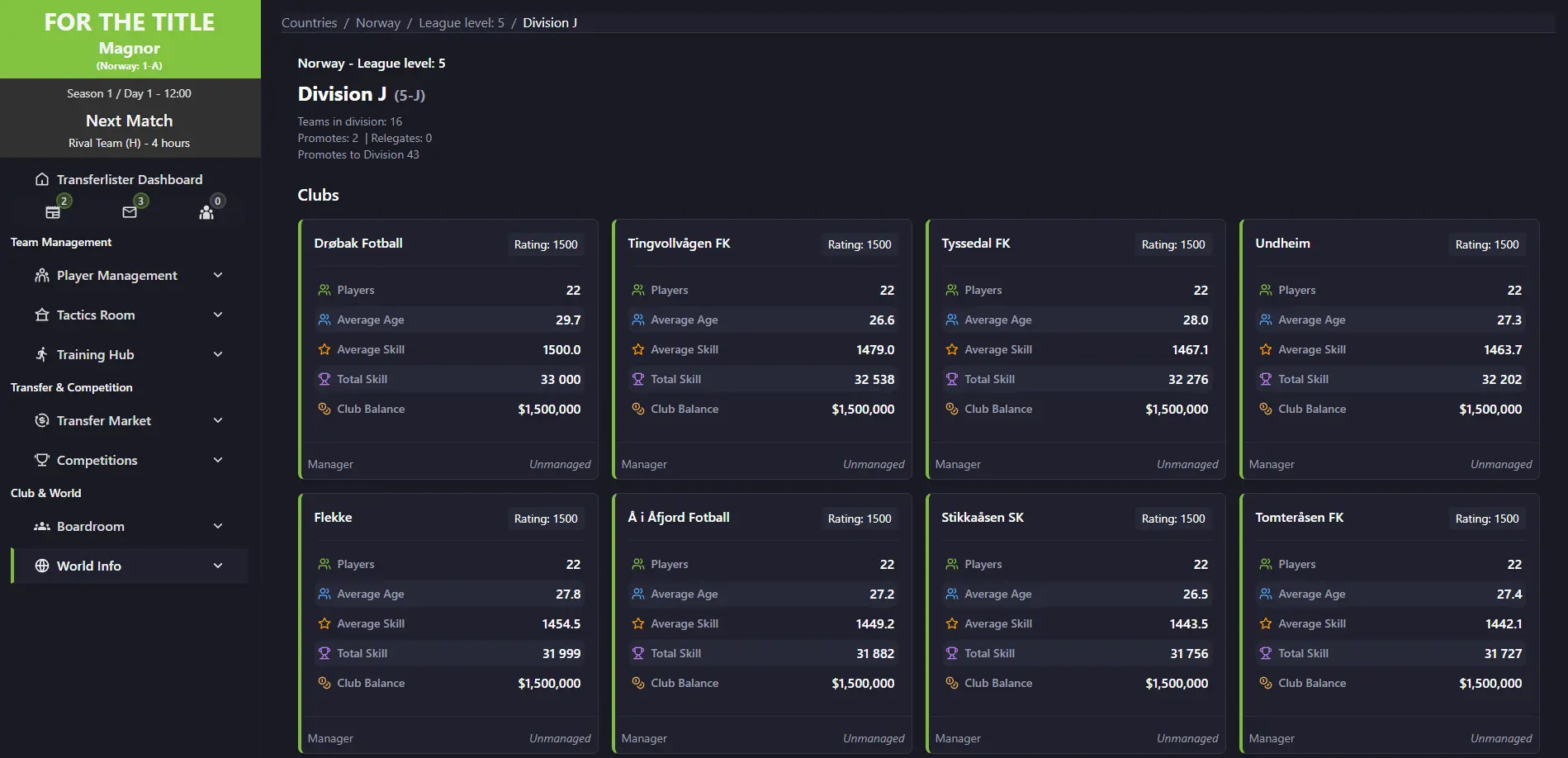
Human-managed and unmanaged clubs share the same structure.
An club managed by an Assistant Manager and no human manager can already have a squad and a place in the pyramid before someone takes control. When a new manager arrives, they inherit the club’s level and the challenge that comes with it.
That manager may take over a promotion contender, a mid-table team or a club that needs urgent work.
The badge is available.
The problems usually come included.
Building a squad for the season
Every generated club begins with 22 players.
This is the starting squad size, not an explicit maximum squad limit.
A fully populated country therefore begins with:
- 496 clubs
- 10,912 starting players
Those players form the foundation of each club’s first squad. Managers then have to assess what the group can do, where it lacks cover and which players may become more important over time.
A 22-player squad gives you options, but it does not guarantee balance.
You may have several players suited to the same role and nobody comfortable elsewhere. You may have strong first choices but little depth. A young player may be worth developing even when a more experienced option offers better immediate form.
Your league position can influence those decisions.
A promotion challenge may encourage you to strengthen now. A relegation fight may expose weaknesses you hoped could wait. A more stable season may give you room to develop players and prepare for the next step.
Squad building is not separate from the pyramid.
It is how you respond to your place within it.
What a season represents
A season is the period in which clubs compete for their position in the pyramid.
Results build the league table. The table creates pressure at both ends. At the conclusion of the competition, the promotion and relegation places determine which clubs move between levels.
The exact fixture format and number of league matches per season are still being developed.
Although each group contains 16 clubs, we are not yet confirming how often every team will face each opponent or how the complete calendar will be arranged. Those details need to work alongside other parts of the game rather than being chosen simply because one format looks familiar.
We are also not using this article to confirm unannounced seasonal rules such as tie-breakers, playoffs or additional competition formats.
Those areas will be explained once they are ready.
What is already clear is the role a season plays: it gives your decisions consequences.
A strong campaign can move your club into a tougher division. A difficult one can send it down. Most seasons will contain something between those extremes: progress, disappointment, development and several results you will still be thinking about three days later.
A pyramid that creates long-term stories
The five-level structure is designed to support more than one successful season.
A club may begin at Level 5 and climb gradually. Another may reach Level 2, fall back and return with a stronger squad. A newly promoted team may survive comfortably, while an established club discovers that reputation does not mark opposing forwards.
Progress will not always be smooth.
That is part of the point.
Promotion matters because staying up is not guaranteed. Relegation matters because there is a route back. Squad development matters because the players who help you escape one level may still be part of the team several seasons later.
As managers join clubs throughout the pyramid, those stories will increasingly cross.
Today’s unmanaged opponent could have a human manager next season. A club promoted alongside you could become a long-term rival. Two teams may climb through several levels together before one finally pulls away.
The structure provides the route.
The managers and players create the history.
Still shaping the season
The national pyramid, group sizes and movement between levels give us the foundation.
We are continuing to develop how seasons are scheduled and presented, including the complete fixture format and the information managers will use to follow their campaign.
When those parts are ready, we will explain what you can see, what you can influence and how the different competitions fit together.
For now, every club has a clear challenge.
Finish in the top two and you move upward. Fall into the bottom four and you move down, unless you are already at the base of the pyramid.
Everything in between is the season you have to manage.