Every Pass Is a Contest
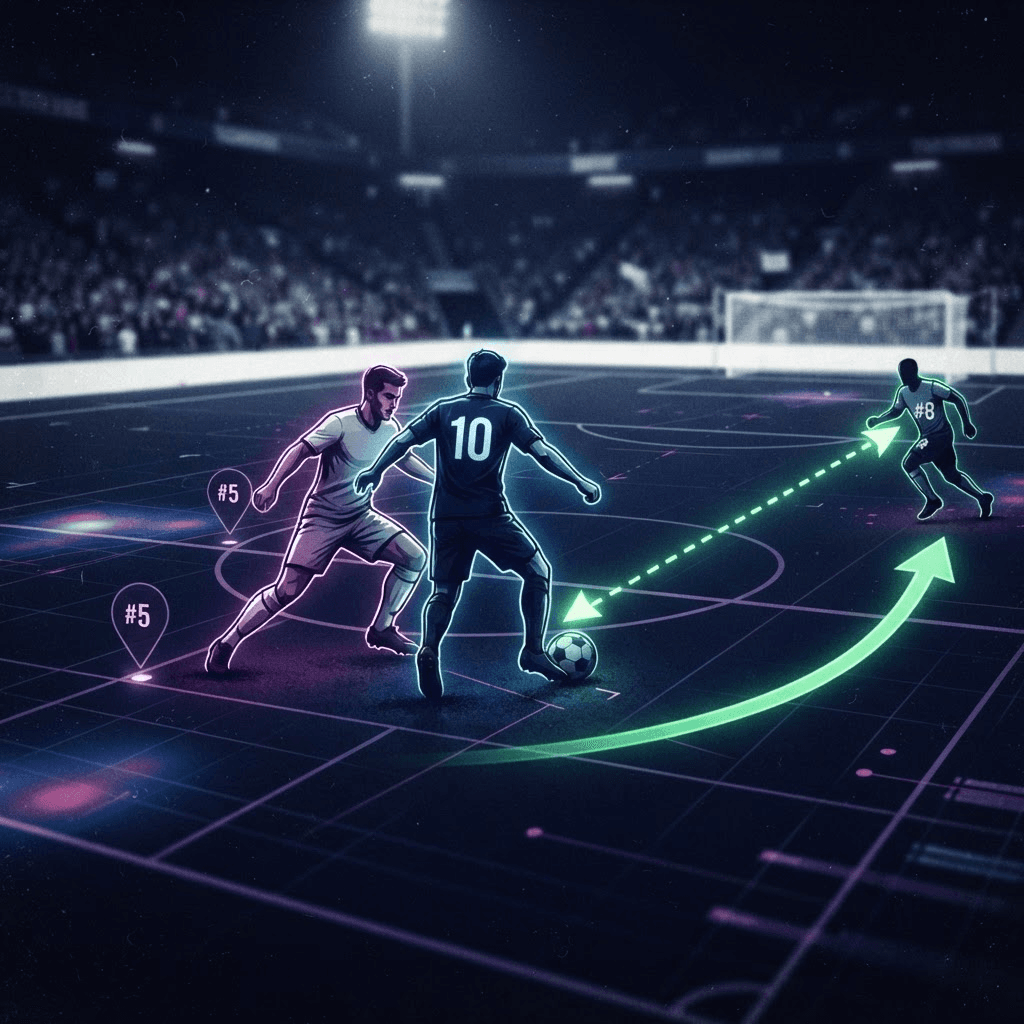
A midfielder receives the ball with his back to goal.
A defender is already closing him down. The striker ahead checks towards the ball, while a centre-back follows tightly.
The midfielder sees the pass.
First, he has to release it before the pressure arrives.
Then the striker has to receive it before the defender takes control.
In commentary, that is one pass.
Inside the For The Title match engine, it is a chain of connected football problems.
The passer must execute. The receiver must control. The defenders must reach, react and compete. The quality of the first action shapes the difficulty of the second.
That is what FTT means by a duel.
Not simply a tackle. Not only a shoulder challenge. Not just two players jumping for a header.
A duel is any contested football situation that helps decide what happens to the ball next.
More than one player against another
In ordinary football language, a duel often means direct contact.
A winger taking on a full-back.
A striker competing with a centre-back.
Two midfielders attacking a second ball.
Those situations are duels in FTT, but the idea is broader.
A pass can be a duel.
A first touch can be a duel.
A cross can contain several duels.
A shot can become one contest with a defender and another with the goalkeeper.
A clearance can be successful without giving the defending team controlled possession.
The engine is trying to answer a football question:
Who can influence this action, how difficult is it, and what kind of situation does the outcome create?
That means a player does not win simply because he has the highest tackling, passing or finishing ability on the pitch.
He must be involved in the right situation.
He must be able to reach it.
He must use the qualities that matter there.
And he must still deal with the next action.
One pass, two football problems
Return to the midfielder and striker.
The first contest happens around the passer.
Can he release the ball cleanly?
Is he balanced?
Is the passing lane open?
Is a defender close enough to disrupt the action?
Can he execute the pass before the pressure becomes decisive?
If he succeeds, the ball travels towards the striker.
Now the second contest begins.
Can the striker reach it?
Can he control it?
Does the centre-back arrive at the same time?
Is the pass played into the correct side of the striker?
Does the first touch protect the ball, move it into space or invite a challenge?
A clean pass gives the receiver a better chance.
A rushed pass may still arrive, but it may force the striker into a much harder reception.
The pass is therefore not one simple check between a passer’s rating and a defender’s rating.
It is a sequence.
The quality of one phase is carried into the next.
Execution comes first
The execution phase is where the initiating player attempts the action.
For a pass, that is the passer.
For a cross, it is the wide player delivering the ball.
For a shot, it is the attacker trying to create and strike the attempt.
For a dribble, it is the player attempting to carry through pressure.
The engine considers the football problem being solved.
A short pass under pressure is not the same as a long diagonal.
A shot from a crowded area is not the same as one taken with time.
A cross delivered after an overlap is not the same as one attempted while the winger is being forced towards the touchline.
Different situations ask different questions of the player.
Technical quality may matter.
Composure may matter.
Body position, distance, pressure and angle may matter.
The defender’s ability to close, block or disrupt may matter.
The exact combination remains part of the match engine.
The public principle is simpler:
Abilities are used according to the football problem the player is trying to solve.
Then somebody has to receive it
If the action survives the first phase, attention moves to where the ball is going.
The intended receiver may need to control a pass, reach a through-ball or attack a cross.
A defender may try to intercept, challenge or clear.
A goalkeeper may judge whether to claim, block or save.
The receiving phase is separate because the football qualities involved can be different.
The passer’s job is to create the delivery.
The receiver’s job is to deal with it.
The defender’s job is to disrupt it.
A technically gifted passer can play a difficult ball well, but the receiver may still miscontrol it.
A poor delivery may still succeed because the receiver adjusts brilliantly.
A defender may lose the first position but recover in time to affect the touch.
This preserves responsibility across the whole sequence.
One player’s good work helps the next player.
It does not complete the action for him.
What momentum means in FTT
Momentum can be a misleading word in football.
It often means a team building confidence, controlling a match or responding to the crowd.
That is not what it means here.
In the duel system, momentum is the advantage or disadvantage carried from one phase into the next.
A crisp pass gives the receiver a cleaner situation.
A poorly struck ball gives the defender more opportunity.
A well-delivered cross helps the attacker compete at the arrival point.
A rushed shot can make the goalkeeper’s task easier.
Momentum describes the quality of the connection between actions.
It does not guarantee the outcome.
A perfect pass can still be wasted by a poor first touch.
A difficult pass can still be controlled by an excellent receiver.
A strong cross can still be cleared by a well-positioned defender.
A rushed shot can still go in if the goalkeeper reacts badly.
The first phase changes the next contest.
It does not remove it.
Space must mean something
A defender should not be able to win every contest simply because he has the strongest defensive profile in the team.
He has to be able to reach the action.
This is where space becomes more than decoration.
A winger who creates separation should gain a real advantage.
A striker who times a run behind the line should force defenders to recover.
A midfielder who receives in a pocket between opponents should face a different problem from one receiving with a marker already touching him.
The engine considers whether a player is close enough and capable of becoming a meaningful participant.
A distant defender may arrive late.
He may influence the next phase instead.
He may be unable to contest the action at all.
This is essential for making movement valuable.
If every defender could challenge every ball regardless of position, then creating space would be pointless and defensive shape would be mostly theatre.
In FTT, where players stand affects what they can influence.
A through-ball is a pass into possibility
A through-ball shows this especially clearly.
The target is not only the receiver.
The target is the space ahead of him.
The passer must recognize that the space exists and attempt to place the ball where the runner can reach it.
The runner must accelerate.
The defenders must turn and recover.
The goalkeeper may decide whether to leave the goal.
The ball may produce a clean reception.
It may create a race.
It may become loose.
It may be intercepted.
It may run harmlessly out of play.
The same player can succeed in one through-ball situation and fail in another because the context is different.
The space may be wider.
The pressure may be lower.
The runner may begin closer.
The defender may be slower to react.
The goalkeeper may be positioned differently.
Skill matters, but skill is always being tested against the situation.
A shot can contain two contests
A shot is also more than one action.
First, the attacker has to create and release the attempt.
A defender may close the lane, block the strike or force contact from a worse angle.
If the ball passes that first challenge, the goalkeeper becomes the next opponent.
The quality of the strike is carried forward.
A clean finish from a strong position creates a harder problem for the goalkeeper.
A hurried effort may reduce the danger.
But again, nothing is automatic.
A goalkeeper can save an excellent shot.
A weak effort can still take a deflection.
A well-struck attempt can miss.
A defender can block the shot before the goalkeeper is involved at all.
Possible outcomes include a goal, save, parry, block, miss or rebound.
Each one creates a different next situation.
Winning does not always mean controlling
Defensive football is often untidy.
A centre-back winning a header does not automatically mean his team begins a clean counterattack.
Near goal, the priority may simply be to remove danger.
A defender may head the ball away.
He may clear into touch.
He may concede a corner rather than risk losing possession centrally.
He may win the first contact but create a loose second ball.
This distinction matters.
A successful defensive action can result in control, a clearance, a deflection or another contest.
That makes defensive sequences feel more believable.
Sometimes the best outcome is possession.
Sometimes it is simply getting the ball away from the six-yard box before anything worse happens.
Why one overall rating is not enough
Two players can have similar broad ratings and still perform very differently.
One midfielder may be an excellent passer but uncomfortable receiving under pressure.
Another may have a secure first touch but choose safe options too often.
A third may see ambitious passes but lack the execution to complete them consistently.
A fourth may be physically strong, reach many second balls and still struggle to progress possession.
The duel system exposes these differences because players are not asked to contribute one number.
They are asked to read, position, reach, execute, control, compete and react.
That makes player profiles matter.
It also makes recruitment and development more interesting.
You are not only asking whether a player is “good”.
You are asking whether he is good at the football problems your tactic repeatedly creates.
Tactics decide which duels appear
A direct system creates more long passes, aerial receptions and second balls.
A possession system creates more pressed first touches, short passing contests and decisions in tight spaces.
Aggressive wide play creates dribbles, crosses and recovery races.
A deep defence creates clearances, headers and loose-ball situations.
A high defensive line creates opportunities to intercept early, but also exposes defenders to races into space.
Your tactic does not guarantee who wins.
It changes the types of contests your players face most often.
That gives managers a useful way to think about squad building.
Who executes the first action?
Who receives it?
Where does the pressure come from?
Can the player reach the duel?
Is the team repeatedly asking somebody to solve a problem that does not suit his profile?
A technically secure midfielder may look ordinary in a system built around aerial transitions.
A powerful striker may dominate direct play but offer less in a team that needs constant movement between the lines.
There is no universal duel specialist.
There are only players suited to particular football situations.
Uncertainty belongs in football
Better players should be more reliable.
They should not be infallible.
Weaker players should be less consistent.
They should not be incapable of succeeding.
Pressure creates mistakes. Narrow contests remain uncertain. Similar situations can produce different outcomes.
The engine allows uncertainty inside the boundaries created by skill and context.
That does not mean results are simply random.
A player’s abilities matter.
Position matters.
Reach matters.
Pressure matters.
The quality of the previous action matters.
But football actions are still performed by imperfect players in changing situations.
The engine should reflect that.
What managers will be able to learn
A duel system becomes most useful when the match output helps explain what happened.
Managers should be able to investigate patterns such as:
Which players repeatedly received under pressure?
Who won aerial first contacts?
Where did passes become loose?
Were crosses being blocked at source or cleared at the arrival point?
Did the striker struggle because the delivery was poor, or because the defender dominated the reception?
Did a high line create interceptions or recovery races the defence could not handle?
These are football questions.
The purpose of the data is to help you ask better ones.
It is not to reveal a calculator that guarantees the next result.
Still being refined
The current engine already contains strong foundations for passing, dribbling, carrying, aerial contests, through-balls, shooting, receiving phases, defender reach, loose balls and changes of possession.
The balance of those situations is still being calibrated.
Some duel families already support a wider range of outcomes than others. Set pieces can also use specialist flows rather than following every open-play sequence in exactly the same way.
The direction is clear, even where the final balance is not.
We want connected football actions, not isolated checks.
We want space and pressure to matter.
We want execution to affect reception.
We want defensive wins to produce clearances, control, deflections and second balls depending on the situation.
And we want players to succeed or fail for football reasons.
From the first touch to the final outcome
A successful action is not only about choosing the right pass.
It is not only about having the highest passing ability.
It is about creating a situation in which the right player can execute, the next player can receive and the team can survive the contest that follows.
The passer matters.
The receiver matters.
The defenders matter.
The space between them matters.
And the quality of one action shapes the next.
That is how FTT turns skills into football.