How Space Creates Decisions in FTT
Freeze the match for a moment.
Your centre-back has the ball.
Ahead of him, a midfielder is dropping into space. The full-back is moving wider. The winger has started a diagonal run. The striker is keeping both centre-backs occupied.
One opponent is pressing from the side.
Another is protecting the central lane.
A third is already thinking about the pass that has not been played yet.
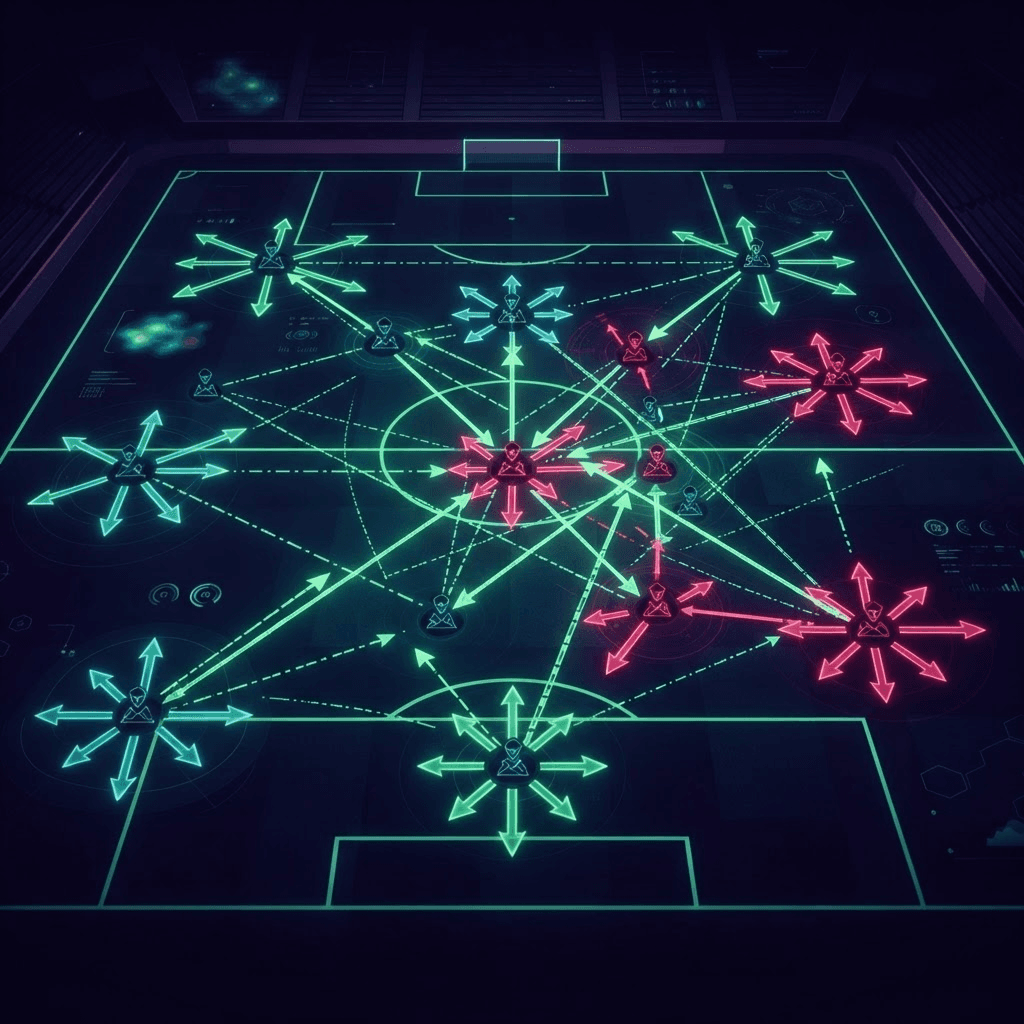
Now imagine arrows around every player.
Some point towards the ball.
Some point away from teammates.
Some pull attackers wider.
Some pull defenders towards goal.
Some encourage a run behind the line.
Others ask a midfielder to stay where he is, because somebody needs to protect the space if possession is lost.
Those arrows are not instructions written in advance.
They are football needs.
The For The Title match engine combines those needs to decide how players move, how space changes and what choices become available next.
Every player is being pulled somewhere
In the FTT movement model, a force is one football reason for a player to move towards or away from a position.
It is not a scripted run.
It is not a fixed animation.
It does not mean the player will definitely reach the suggested area.
A force might encourage a winger to preserve width. Another may pull him inside because the full-back has overlapped. A third may keep him aware of the offside line. A fourth may draw him closer to the ball because the team needs support.
The final movement comes from the combination.
That matters because football players rarely have only one responsibility.
A full-back may want to support the attack, remain wide, stay connected to the centre-back and remain ready to recover.
A midfielder may want to offer a passing angle, protect the centre, avoid occupying the same space as a teammate and prepare for a second ball.
A striker may want to come short, pin the defensive line and threaten the channel behind it.
Those needs can pull in different directions.
The player’s movement is the compromise.
Formation provides structure, not rails
Every player begins with an attacking and defensive reference position.
These positions give the team its underlying shape.
They help define where a player generally belongs when the team has the ball and where he should return when defending.
But they are anchors, not cages.
A central midfielder may have an attacking position ahead of the ball, yet stay deeper because the full-backs have both advanced.
A winger may begin wide but move inside because the opposition full-back has followed the overlap.
A centre-back may step forward to engage an attacker while his partner drops to cover the space behind him.
The formation tells the players where home is.
The live match tells them when they need to leave it.
This is why two teams using the same formation can behave very differently.
One may keep its structure and progress carefully.
Another may push players beyond their starting positions and accept more space in transition.
The picture on the tactics screen is the starting point.
The football begins when that picture starts moving.
One movement purpose at a time
A useful principle behind the engine is that each force represents one clear football purpose.
Instead of one enormous instruction saying:
“Overlap unless the winger stays wide, except when the defensive midfielder has moved forward and the opposition striker is threatening the channel,”
the engine can combine simpler ideas:
Support the attack.
Preserve width.
Avoid duplicating the winger.
Protect the space behind the ball.
Stay connected to the defensive line.
Recover if possession changes.
Each purpose is understandable on its own.
The visible behaviour emerges from how they interact.
This gives the movement model flexibility without requiring every attacking pattern to be scripted in advance.
The full-back overlaps because the situation encourages it, not because the fifth pass has triggered a pre-written routine.
Attackers move to create possibilities
Attacking movement is not only about running towards goal.
Players can move to create width, offer support, build triangles, enter half-spaces, arrive in the penalty area or stay behind the attack as protection.
A winger moving wider may stretch the defence.
That can create more room centrally.
A striker running behind may never receive the pass, but the run can force the defensive line to retreat.
That may give the ball carrier more space to advance.
A midfielder stepping closer may create a safe option.
That may make holding the ball useful for another moment.
A full-back overlapping may create a two-against-one on the flank.
It may also leave space behind him if possession is lost.
Every attacking movement creates an opportunity and a possible consequence.
That is the trade-off.
Defenders do more than chase the ball
Defensive movement is built from competing responsibilities too.
The nearest defender may press the carrier.
Another may cover behind him.
A midfielder may screen the pass into the striker.
A centre-back may protect the central lane rather than follow an attacker into a less dangerous area.
A full-back may step wide to engage while the rest of the line shifts across.
The best defender is not always the one moving fastest towards the ball.
Sometimes the correct action is to hold position.
Sometimes it is to delay.
Sometimes it is to block the space that would make the next pass dangerous.
This helps the engine represent defending as a team problem.
Pressure, cover, compactness and recovery are connected.
If one player steps out, somebody else must decide what to protect.
Intention is not the same as arrival
Forces describe where the player wants to go.
Physical ability affects whether he gets there.
A defender may recognize the danger and begin the correct recovery run, but still arrive too late.
A winger may see an open channel and have the acceleration to attack it immediately.
A midfielder may want to change direction under pressure but lack the agility to escape cleanly.
Pace, acceleration and agility therefore become tactical qualities.
They do not only make players “faster”.
They affect whether the player can carry out the movement the situation demands.
This distinction also creates useful opportunities for match analysis.
The game can eventually show that a defender was moving towards the right area, even though he could not reach it in time.
The decision may have been sound.
The execution may not have been enough.
The ball carrier reads the changing picture
The player with the ball faces a different problem.
He is not only moving.
He must choose.
Should he shoot?
Can he play a runner behind the defence?
Should he pass now?
Would carrying the ball improve the situation?
Should he hold possession and wait for movement?
Would a sideways step open a better passing lane?
Is the safest option to move backwards and reset?
The engine uses broad decision areas to represent those questions.
These are not exposed pressure meters or public calculations.
They are football problems the player must interpret.
Is this a shooting situation?
The player does not shoot simply because he has entered one fixed area.
He considers the shape of the opportunity.
Is the angle useful?
Is a defender closing?
Is the route to goal open?
Is a teammate in a stronger position?
Could another touch improve the chance?
Would holding the ball allow the attack to develop?
The player’s football understanding influences how well he reads the opportunity.
His technical and physical qualities then affect whether he can execute the choice.
A good decision can still produce a poor shot.
A risky decision can still succeed.
A defender can turn a promising attempt into a block.
The choice and the outcome are separate parts of the football.
Is there a through-ball?
A through-ball requires more than a striker being present.
There must be useful space.
A runner must be able to attack it.
The passing lane must exist.
The timing must be right.
The passer must recognize the opportunity before it closes.
A defender stepping forward may create the chance.
A defender dropping may remove it.
A winger’s movement may pull one marker away and open a channel for somebody else.
The target is not simply the receiver’s current position.
It is the space where the ball and runner might meet.
That is why off-ball movement changes decisions even when the moving player never touches the ball.
Should the player carry, hold or pass?
Open possession should not become an endless chain of forced passes.
Sometimes the ball carrier has space to change the situation himself.
He may drive forward.
He may advance more carefully while keeping support around him.
He may move laterally to change the passing angle.
He may hold the ball briefly and draw a defender.
He may recycle possession and give the team more time.
Holding is an active decision.
It can allow a runner to move, a full-back to overlap or the team’s shape to settle.
But it is only useful while the picture is changing.
If the carrier waits without creating anything new, the pressure becomes more dangerous and another choice is needed.
There is a difference between patience and standing still until somebody tackles you.
Football remains helpful that way.
What the player sees
The ball carrier reads several broad signals from the match.
How much useful space exists ahead?
How quickly is pressure arriving?
How crowded is the likely route forward?
Is the defensive line stepping up or retreating?
Would moving sideways improve the next action?
How dangerous would a turnover be?
Are teammates creating useful support?
These are objective parts of the situation.
The player’s understanding of them is not perfect.
Two footballers standing in the same place may read the moment differently.
One may recognize that the defence is retreating and carry forward.
Another may release the ball too early.
One may see a runner.
Another may miss him.
One may remain composed under pressure.
Another may rush an ambitious pass into a crowded area.
Vision, anticipation, insight, composure and decision-making shape the quality of the read.
Better players are not given complete knowledge.
They are more likely to interpret the developing football clearly and choose with greater stability.
A good choice can still fail
Decision quality and execution quality are different.
A player may correctly recognize the through-ball and underhit it.
He may choose the right pass and see the receiver lose the duel.
He may make a poor choice but execute it so well that the move still succeeds.
He may choose and execute well, only for the opposition to defend even better.
This separation is central to believable player identity.
A clever midfielder with limited technique should not behave like a technically gifted player with weak decisions.
Their errors should look different.
One sees the game but cannot always perform the action.
The other can perform difficult actions but may choose the wrong one.
One pass reorganises the whole pitch
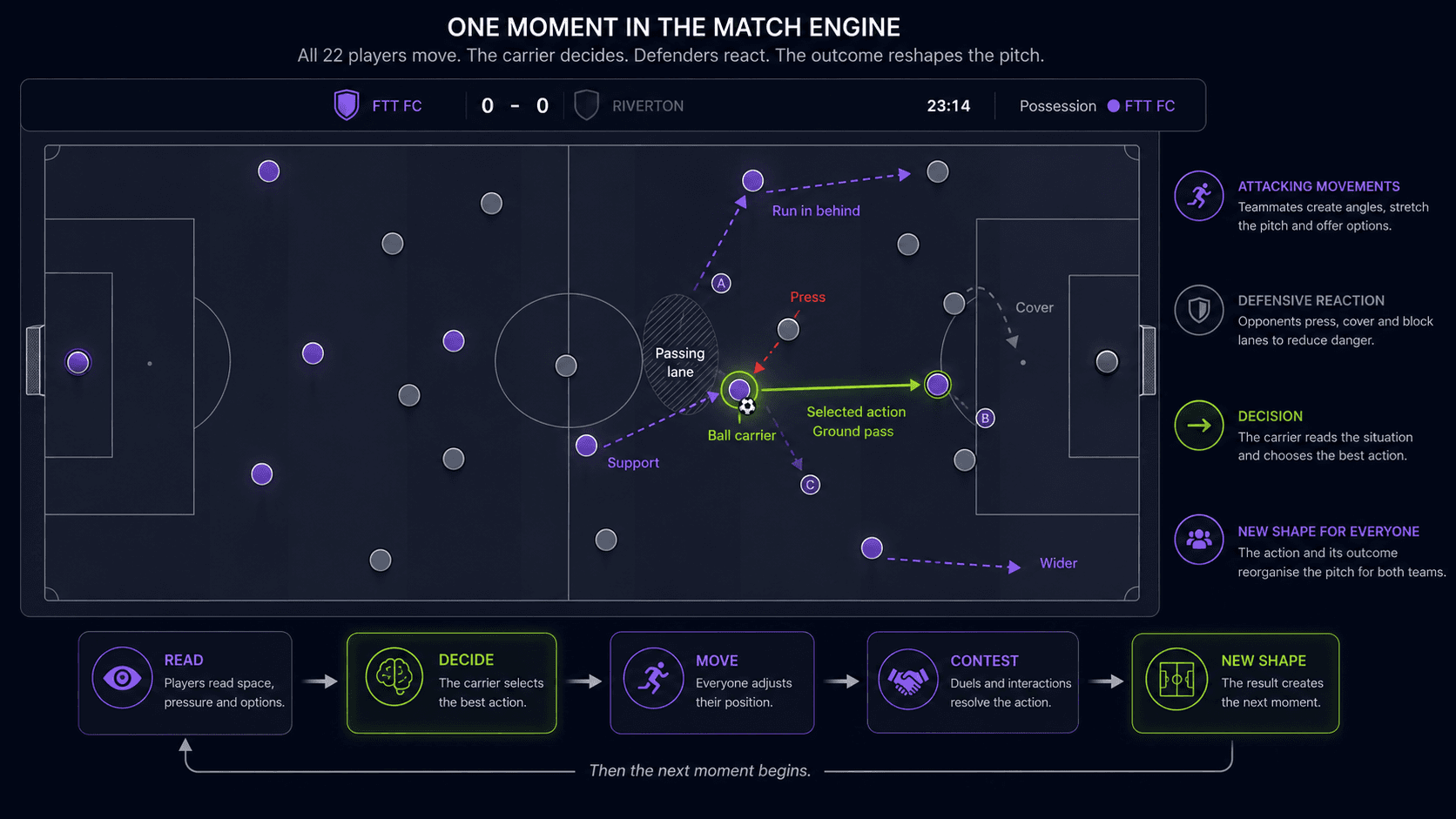
Return to the centre-back from the opening moment.
He carries forward.
The pressing striker continues to close him down.
An opposition midfielder steps towards the ball.
The full-back becomes free.
The winger’s diagonal run forces the defensive line backwards.
A central passing lane opens briefly.
The centre-back passes wide.
Now every movement need changes.
The full-back becomes the ball carrier.
The winger moves inside.
The striker attacks the box.
The far-side winger begins moving towards the back post.
The midfield adjusts to protect against a counterattack.
The defence shifts towards the flank.
The original centre-back may now hold a deeper position in case possession is lost.
One completed pass has reorganised all 22 players.
That is the feedback loop behind the engine:
Forces create movement.
Movement changes space.
The ball carrier reads the space.
The player chooses an action.
The action creates a duel or a carry.
The outcome changes possession and position.
Every force is reconsidered.
Then the next moment begins.
Emergent football rather than rehearsed theatre
The engine can produce recognisable football patterns:
Overlaps.
Supporting triangles.
Runs behind.
Defensive cover.
Compact blocks.
Switches of play.
Recovery sprints.
Box arrivals.
Counterattacks.
But the aim is not to script them in a fixed order.
The same tactic should preserve its football identity while still producing variation.
A full-back may overlap in one attack and remain deeper in the next.
A striker may drop to connect play, then attack the space behind when the defence steps forward.
The pattern appears because the movements and decisions make it appropriate.
Not because the match has reached page four of the choreography.
What this means for managers
When a tactical plan struggles, the problem may not be one thing.
The movement may be poor.
The spacing may be crowded.
The ball carrier may be making weak decisions.
The decision may be correct but poorly executed.
The opposition may be positioning well.
The selected player may be solving the wrong football problem.
A role combination may be pulling too many players into the same space.
Managers should be able to investigate questions such as:
Does the team provide enough support around the ball?
Are runners creating useful space?
Do the full-backs leave the rest defence exposed?
Which players are asked to make decisions under the most pressure?
Does the team create forward space, or repeatedly run into congestion?
Are defenders closing the ball while somebody else covers?
The match data should help separate those causes.
It should show what happened without providing a formula that guarantees the next result.
What we are still refining
The force-based movement foundation is already an important part of the FTT match engine.
Attacking, defending and ball-carry movement are represented. Players use formation anchors, role-aware behaviour and physical movement limits. Shooting and through-ball decisions are connected to the live situation.
We are still validating and rebalancing parts of this model.
Some positions currently have more specialised behaviour than others. Several movement families remain under active tuning. The richer ball-carry decision system is also being tested carefully before it becomes a universal part of every match flow.
Tactical familiarity, fatigue and detailed manager instructions are not yet complete influences across the whole movement system.
The concept is established.
The balance is still being worked on.
A moving network
The match is not a sequence of isolated choices.
It is a moving network.
Every player changes the space available to every other player.
A winger creates a lane for a midfielder.
A pressing forward removes time from a centre-back.
A covering defender makes a run less attractive without touching the ball.
A striker’s movement can push the line back and change the carrier’s decision.
Each choice changes the next set of movements.
Each movement changes the next choice.
Every player is constantly pulled by different football needs.
Those movements reshape the problem faced by the ball carrier.
And the ball carrier’s decision reshapes the match for everyone else.