More Than an Overall Rating

Two midfielders can look almost identical on the squad screen.
They are the same age. They play in the same area. Their broad ratings are close enough that you could reasonably spend several minutes moving between their profiles and pretending the answer will eventually reveal itself.
Then the match starts.
The first midfielder sees a pass through the defensive line before the run is obvious. He releases it cleanly, but struggles when opponents get close enough to make the game physical.
The second carries the ball powerfully, covers ground quickly and survives contact. He is harder to knock off the ball, but he sometimes misses the more ambitious option.
Which player is better?
Better for what?
That question sits at the centre of the player-skill system in For The Title.
A footballer is not one number. He is a collection of qualities that become valuable — or exposed — when the match asks the right question.
The footballer behind the summary
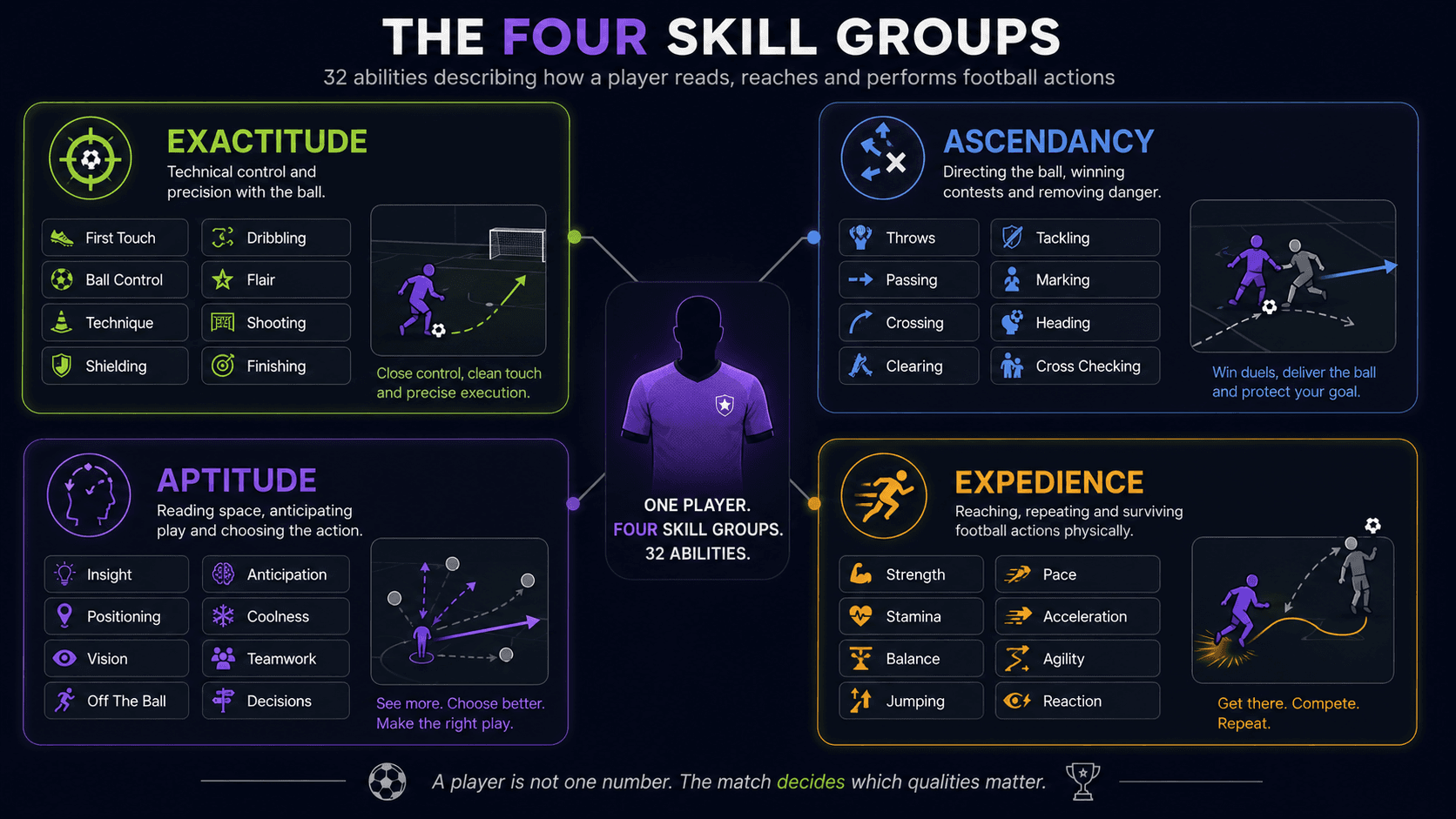
Every player in FTT has 32 detailed abilities.
Those abilities are divided equally into four skill groups:
- Exactitude — technical control and precision
- Ascendancy — distribution, defensive execution and contested situations
- Aptitude — football intelligence and decision-making
- Expedience — physical and athletic execution
Broad positional ratings still have a purpose. They help you scan a squad and understand whether a player appears suited to goalkeeping, defending, midfield or attack.
Proficiency gives you another high-level view of the ability present across the complete profile.
But neither is a verdict.
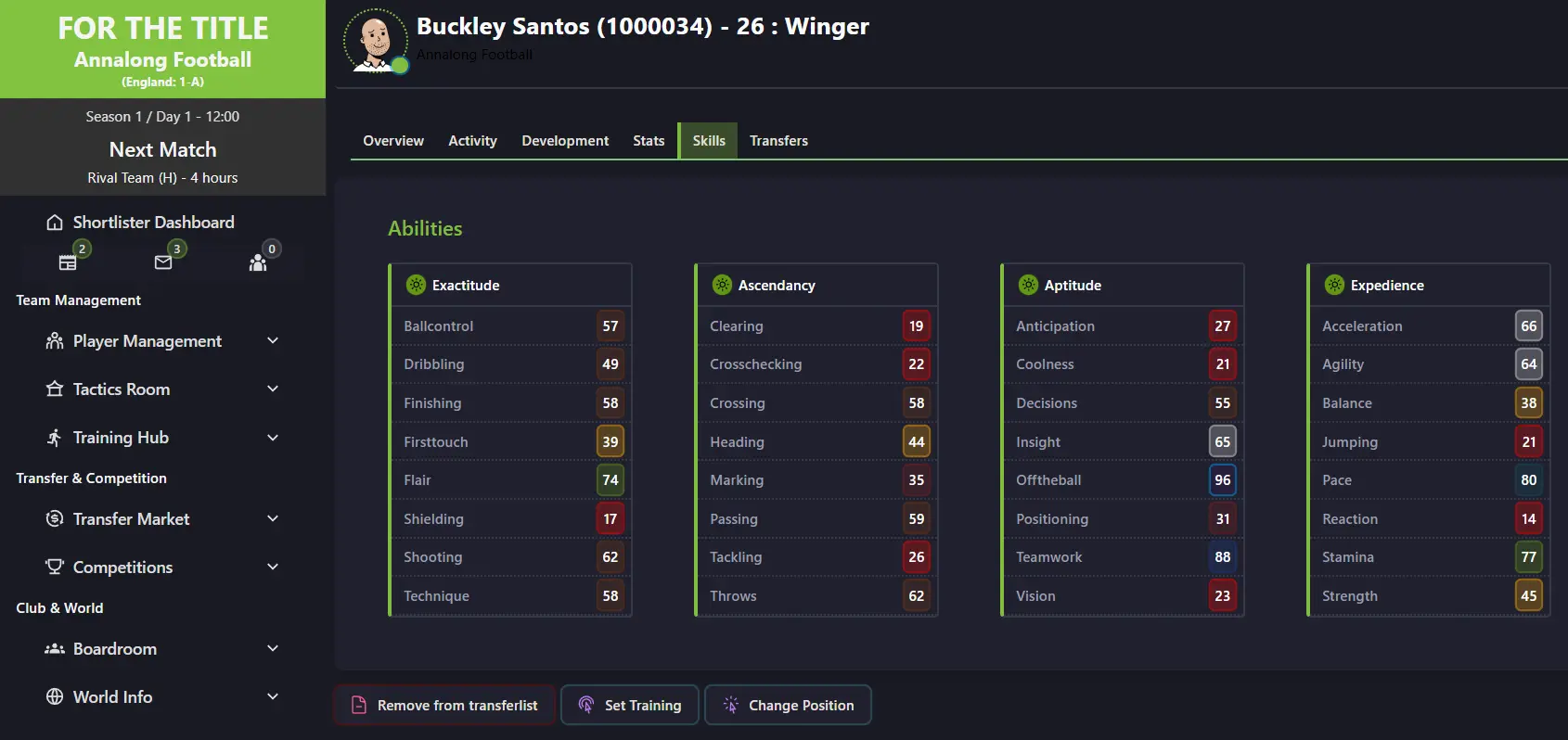
Two players with similar proficiency can solve completely different football problems. One may be a balanced all-rounder. Another may be a specialist with one outstanding weapon and several areas you will need to protect.
The detailed profile explains the player behind the summary.
Exactitude: what happens at the player's feet
Exactitude represents technical control, precision and the quality of the player's contact with the ball.
It includes First Touch, Ball Control, Technique, Shielding, Dribbling, Flair, Shooting and Finishing.
These qualities are connected, but they are not interchangeable.
A striker may finish chances reliably without being able to dribble past defenders.
A midfielder may have a wonderful first touch and excellent technique but offer very little threat near goal.
A winger may beat opponents consistently and then produce a shot that suggests the corner flag had become the intended target.
Exactitude answers questions such as: Can the player bring the ball under control? Can he keep it while moving? Can he execute a difficult action cleanly? Can he protect possession? Can he strike the ball effectively?
The exact ability that matters depends on the situation.
First Touch is important when receiving. Finishing matters at the final scoring contact. Shielding becomes valuable when a player has an opponent at his back and needs time for support to arrive.
No single technical ability completes the whole footballer.
Ascendancy: directing and winning the situation
Ascendancy represents the player's ability to impose himself on a football action.
It includes Throws, Passing, Crossing, Clearing, Tackling, Marking, Heading and Cross Checking.
Passing and tackling may look like unusual neighbours, but they share a wider football idea. Both try to control where the situation goes next.
A pass directs possession. A cross delivers the ball into an attacking area. A tackle attempts to take control away from an opponent. A clearance removes danger when neat possession is less important than not conceding. Heading directs an aerial contact. Marking reduces an opponent's ability to influence the play.
Cross Checking describes physical contact and body position in crowded crossing and aerial situations. It is about holding or denying space before the ball arrives, not checking whether the winger has crossed accurately.
A centre-back with strong Heading but limited Jumping may read the delivery well yet struggle to reach it.
A full-back with good Crossing but poor Decisions may deliver well after choosing the wrong moment.
Once again, the ability belongs inside the football problem.
Aptitude: seeing what happens next
Aptitude represents football intelligence.
It includes Insight, Positioning, Vision, Off The Ball, Anticipation, Coolness, Teamwork and Decisions.
These qualities shape what the player sees, expects and chooses.
A midfielder may possess the passing quality needed for a through-ball but fail to recognise the run. A striker may finish well but arrive in the wrong area. A defender may tackle strongly but step forward when he should have covered. A winger may have the dribbling ability to attack space and still carry the ball into a crowd.
Aptitude separates seeing from doing.
Vision helps a player notice options. Anticipation helps him read what may happen next. Positioning helps him occupy useful space. Off The Ball shapes the timing and purpose of movement without possession. Decisions influences the action he selects. Coolness helps maintain stable judgement when the situation becomes hurried or uncomfortable.
A player can make a clever choice and execute it badly. Another can perform a difficult action beautifully after choosing an option that probably should not have been attempted.
Football contains both. Usually in the same match.
Expedience: reaching and surviving the action
Expedience represents physical and athletic execution.
It includes Strength, Stamina, Balance, Jumping, Pace, Acceleration, Agility and Reaction.
These abilities are not separate from tactics.
Pace helps a runner threaten space behind the defensive line. Acceleration helps a defender close the first few metres. Agility helps a winger change direction. Balance helps a midfielder remain in control through contact. Reaction matters when the ball deflects, rebounds or changes direction unexpectedly. Strength supports hold-up play and physical contests. Stamina represents the ability to repeat demanding football actions over time, although the full match-long fatigue model is still being developed.
A player may understand exactly where he needs to go and still arrive too late.
That is how physical ability becomes tactical. Speed gets him there. The rest decides what happens next.
An athletic starting point is not a finished player
Consider a young winger with excellent Pace and Acceleration.
At first glance, the profile looks exciting.
Then you look closer.
His First Touch is unreliable. His Crossing is limited. His Off The Ball movement is still developing.
He can run quickly, but he may start at the wrong moment. He may struggle to control the pass. He may reach a promising position and waste the final delivery.
The player is not a finished winger. He is an athletic starting point.
You could train his First Touch and Crossing directly. Match opportunities may help him improve his timing and understanding of space.
There is potential in the profile, but not a guarantee.
Youth, pace and optimism have created many transfer fees. They have not always created many assists.
What you know depends on your relationship with the player
For players at your own club, you can see the detailed current profile.
That reflects the club's daily access to the footballer through training, selection and match preparation.
You know his current abilities. You can connect those ratings to his training, condition, motivation and development history.
You still do not receive a perfect forecast of his future. Exact talent, potential and final ceiling remain uncertain.
For an unscouted player at another club, the information is less precise. Instead of exact detailed values, abilities are shown through broad tiers from S+ to G.
That lets you recognise the shape of the player. You may see that a winger appears very quick, strong at dribbling and less convincing in his delivery. That is enough to create interest, but not enough to know the exact difference between him and another target.
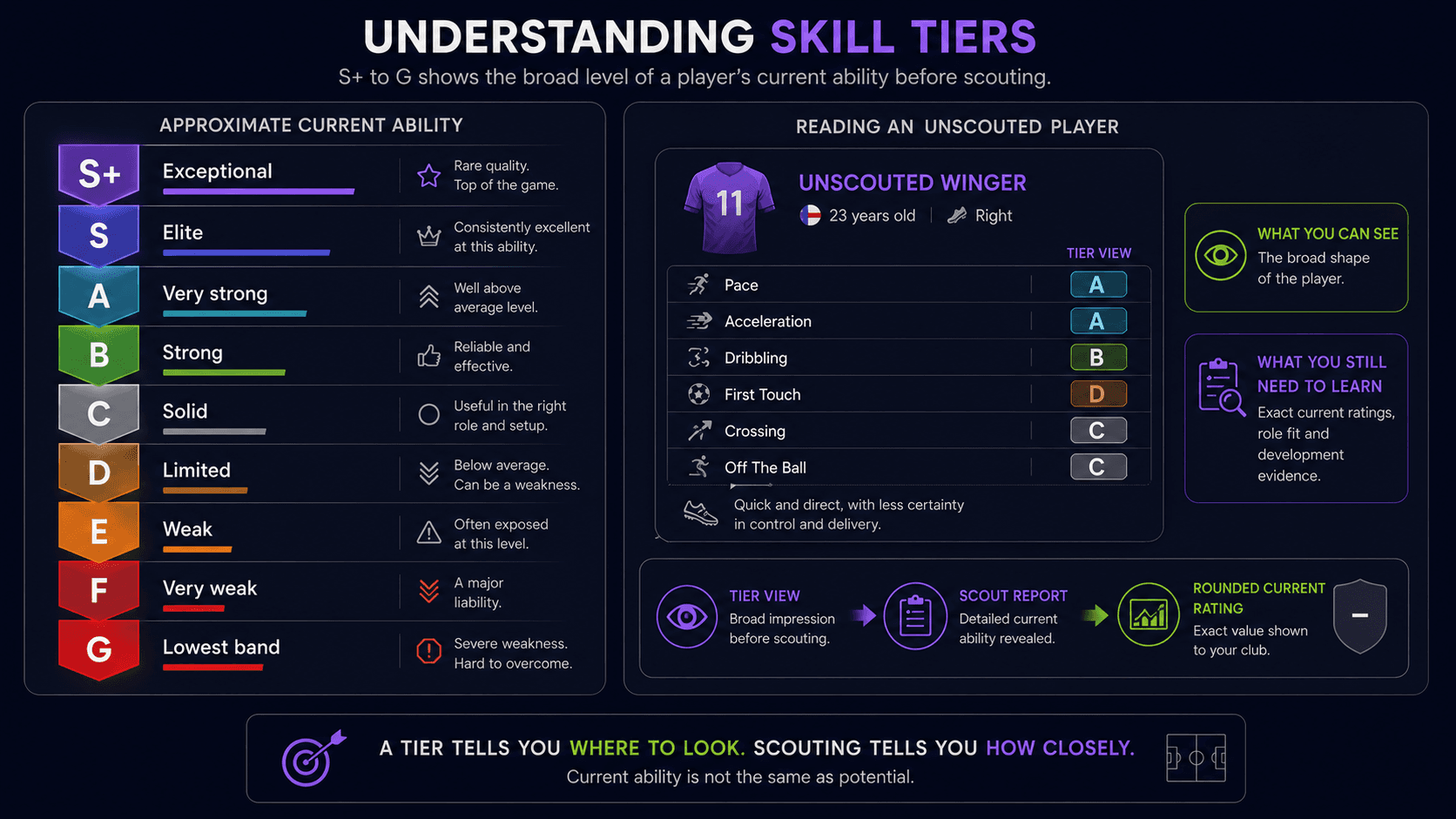
A letter tier tells you where to look. A scout report tells you how closely.
Scouting sharpens the picture
Scouting turns a broad external impression into a more detailed view of the player's current abilities.
The report belongs to the manager who requested it. Another club does not automatically gain the same information because you did the work.
In the current version, scouting is a straightforward step. It unlocks exact rounded current-ability ratings for that player.
Scouting provides better evidence. It does not provide prophecy.
You still need to compare the player with your squad, your role requirements and the football you want to play.
Some qualities are trained. Others are learned by playing.
The 24 abilities in Exactitude, Ascendancy and Expedience can be trained directly.
You can work on qualities such as First Touch, Passing, Tackling, Finishing, Strength, Pace and Reaction.
The eight Aptitude abilities follow a different path. They are intended to develop mainly through match experience.
That distinction matters.
A young midfielder can improve Passing and Technique on the training ground. He still needs matches to learn when to release the ball, where to stand before receiving and how to recognise pressure before it arrives.
A striker can train Finishing. He still needs experience to improve his movement, anticipation and decisions in the penalty area.
A defender can train Tackling and Heading. He still needs football situations to learn when to step forward, when to cover and how to coordinate with the defensive line.
The full process connecting match experience to Aptitude growth is still being completed and balanced. The principle, however, is central:
Technical and physical qualities can be drilled. Understanding the match requires playing the match.
Abilities work together
No ability operates alone.
Receiving under pressure may call on First Touch, Ball Control, Balance, Anticipation and Positioning, while the defender brings his own pressure and marking qualities.
A run behind may depend on Off The Ball, Anticipation, Acceleration and Pace, along with the passer's ability to see and deliver the ball.
Hold-up play may involve Shielding, Strength, Balance, First Touch and Coolness.
An aerial contest may draw on Heading, Jumping, Strength, Positioning, Anticipation and body-position control.
These examples describe football relationships, not engine recipes. The exact combinations and importance of each ability depend on the situation.
The useful principle for managers is this: the match asks different questions, and each player answers with a different combination of qualities.
Reading a player for a role
The best way to assess a profile is to begin with the job.
What do you need this player to do? Where will he receive the ball? Which opponents will he face? Which situations will your tactic create for him?
Then look at the shape of the profile. What are the two or three qualities that make him useful? Which weakness may stop him from using those strengths?
That limiting ability is often more important than the lowest number on the profile.
Not every weakness needs to be corrected. Some can be protected by the team. Others may prevent the player from performing the role entirely.
That is your decision.
Position does not rewrite the footballer
Changing a player's selected position does not change his underlying abilities.
A technically secure full-back does not suddenly gain midfield intelligence because you move his marker on the tactics board.
A winger moved into attack keeps the same First Touch, Finishing, Decisions and Strength.
The new position changes the football situations he is likely to face. It changes which parts of the profile become important more often.
Position is a responsibility, not a character class.
That allows players to be versatile, unusual or difficult to place. Sometimes the best role is obvious. Sometimes it takes a few matches and one slightly desperate tactical experiment.
The player page is evidence
A high rating makes a player more capable and reliable in relevant situations.
It does not guarantee the outcome.
Football still depends on the opponent, the movement, the angle, the pressure and what happened immediately before the action.
That is why the player page should not feel like an answer sheet. It is evidence.
FTT shows you the footballer: his strengths, weaknesses, physical qualities, technical habits and understanding of the game.
It does not tell you the one correct way to use him.
That part belongs to the manager.