More Than the Highest Bid: How Transfers Work in FTT

Transfers rarely begin with a transfer.
They begin when your full-back looks uncomfortable defending the entire right side by himself. They begin when your midfield controls possession but creates very little with it. They begin when an experienced striker is still scoring goals, but you know the squad needs to prepare for what comes next.
Recruitment in For The Title should start with a football problem.
The transfer market gives you a way to solve that problem, alongside options like training the players already at your club, changing their roles or giving a younger player an opportunity.
But finding an available footballer is only the first step.
The selling club must be prepared to let him leave. Your club must be willing and able to pay. The player must also believe the move is right for his career.
When all three agree, you have a transfer.
When they do not, you still have a shortlist and a slightly bruised recruitment plan.
Start with the squad, not the market
It is easy to open a transfer list and begin sorting by the largest numbers available.
That is certainly an approach. Your budget may have some observations.
A better starting point is to understand what your team actually needs.
Are you looking for an immediate starter or reliable cover? Does the player need to fit a high defensive line, protect the midfield or create chances against a deep defence? Are you replacing an older player, preparing a young prospect or adding depth before a promotion challenge?
The same player can be an excellent signing for one club and an unnecessary expense for another.
A quick winger may improve a team that attacks space during transitions. He may be less useful to a side that already has three similar players and nobody capable of controlling the centre of the pitch.
Recruitment is therefore part of squad building rather than a separate collection game.
The strongest available player is not automatically the right player. Sometimes you need a skillset suoting your playstyle and division, rather than a good alrounder. For The Title provide you with the options.
Finding possible targets
Managers can discover players through the transfer market, by browsing the wider football world, through scouting and from their own shortlist.
An active transfer listing can provide useful information such as the player’s:
- Position
- Age and nationality
- Current club
- Broad football ratings
- Calculated player value
- Asking price
- Current leading bid
- Number of bids
- Time remaining
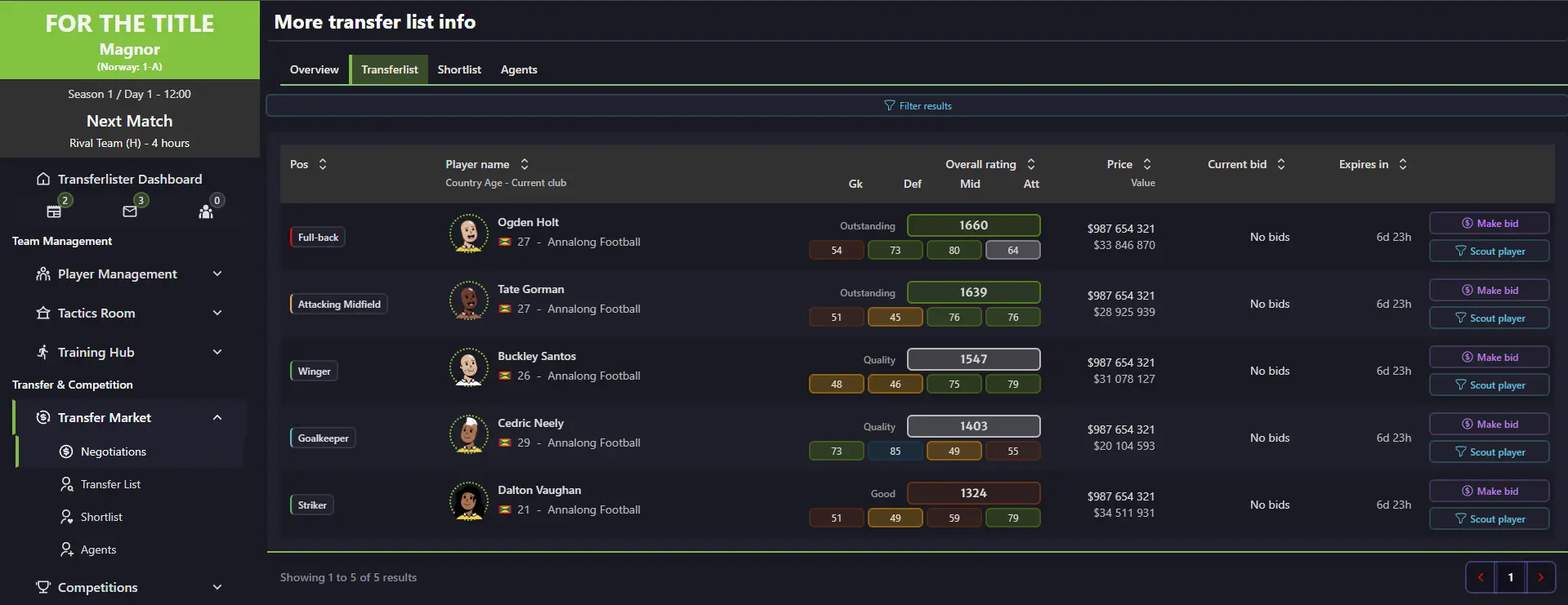
Filters and sorting help narrow the search. You might look for a particular position, an age range, a level of current ability or players available within the club’s likely budget.
That makes the market easier to explore, but it does not make the decision for you.
A player being available does not mean he fits your shape. A reasonable asking price does not guarantee good value. A high broad rating may hide a profile that suits a completely different style of football.
The market shows you the opportunity.
Scouting and comparison help you understand it.
Scout first, explain later
A transfer listing tells you that the selling club is willing to consider a deal. It does not provide a complete answer about the footballer.
Before bidding, you may want to investigate how the player compares with your current options.
What are his main strengths? Does his stats match your expectations= What system, position, role and formation has he been contributing? Which weaknesses might your tactic expose? Can he perform more than one role? Is he ready to contribute immediately, or will he need time and development? Is he close to his peak, late bloomer or rapidly gaining skills towards his potential?
Scouting and understanding his strengths and weaknesses improves the information available to you, but it is not intended to reveal every hidden detail of a player’s future.
You should be able to make an informed judgement without receiving a guarantee.
A player may look like a promising addition and still develop more slowly than expected. Another may appear less exciting but fit your team so well that his performances exceed his individual profile.
That uncertainty is part of recruitment.
The aim is not to find a button marked “correct signing”. Football has resisted introducing one of those so far.
Building a shortlist
The shortlist sits between interest and commitment.
You can use it to follow an immediate target, keep an alternative available or monitor a player whose situation may change.
A shortlisted player could be:
- Your preferred signing
- A cheaper alternative
- A possible replacement for a current squad member
- A younger player to revisit later
- Someone whose price is currently higher than your enthusiasm
A useful recruitment plan should rarely depend on one player alone.
The market may become competitive. The asking price may be unrealistic. Another manager may be prepared to go further. The player may decide that another club offers a better opportunity. A bargin bid may suddenly be accepted.
Having alternatives is not a lack of confidence. It is what happens when the sporting director remembers that other clubs also exist.
Putting a player on the market
A manager can place a player owned by their club on the transfer list.
The listing includes an asking price and a deadline. While it remains open, other clubs can inspect the player and decide whether to bid.
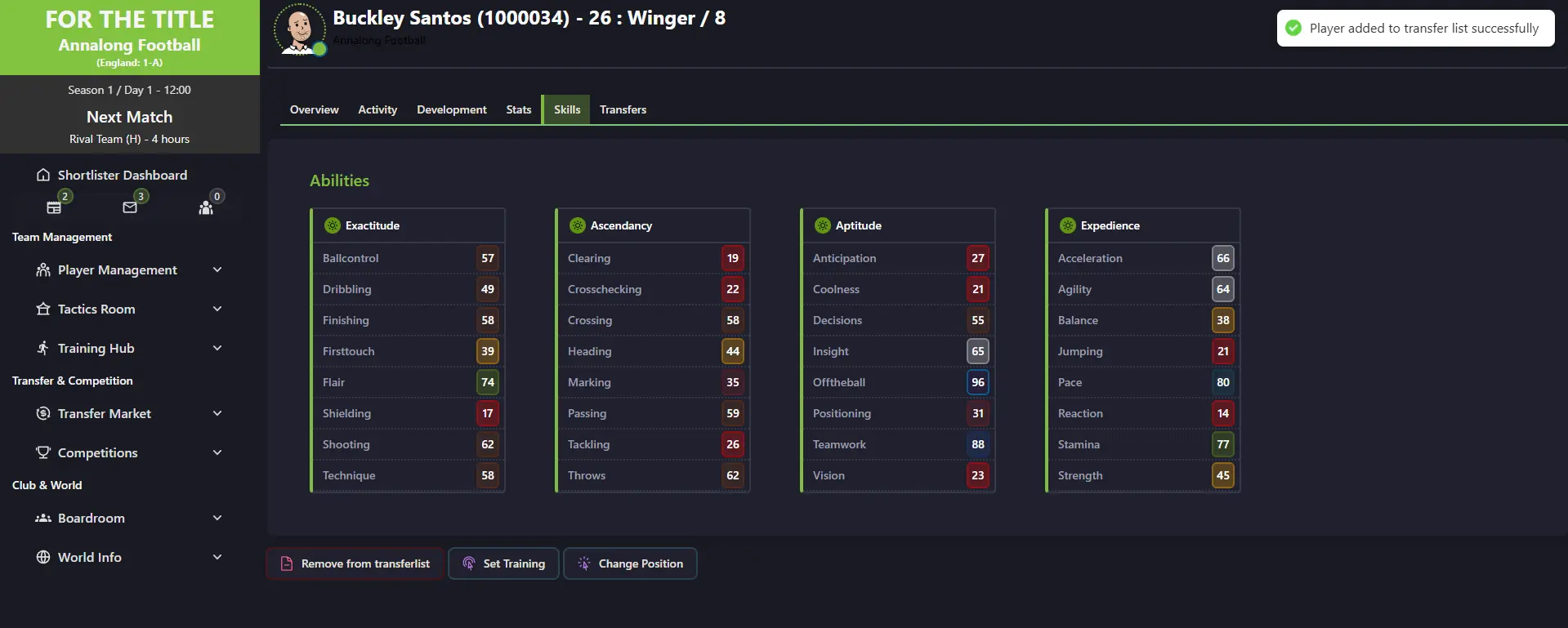
The asking price represents the selling club’s expectation. It is not an official statement of the player’s exact worth.
A manager may set a higher price because the player remains important, would be difficult to replace or is expected to attract several clubs.
A lower price might be used when the player is no longer part of the plans, the club needs funds or the manager wants to encourage interest quickly.
This creates an important distinction between several numbers.
The player’s calculated value is the game’s broad assessment of his football profile. The asking price is chosen by the seller. The current bid reflects the competition so far. The final fee is what the market ultimately produces.
There is also another value that cannot be summarized so neatly: what the player is worth to your team.
A defensive midfielder may be worth more to a club with no protection in front of the back line than to one already carrying four of them.
Context matters.
Listing a player is a commitment
A seller can remove a listed player while no active bids have been made.
Once another club has placed a valid bid, the process becomes more serious. The seller cannot simply withdraw the player after other managers have committed money and adjusted their plans.
This protects the market from becoming a series of advertisements that disappear whenever genuine interest arrives.
The football principle is straightforward:
Placing a player on the market is a meaningful decision. Once other clubs act on it, the selling club has responsibilities to the process.
Before listing someone, you should therefore consider what happens if the player actually leaves.
Do you have a replacement? Can another squad member take the role? Are you selling because the offer would improve the club, or simply because you have not used the player recently?
A transfer can solve one problem while creating another.
Competing for a player
A manager can bid only for a player owned by another club.
The market can show the current leading offer and the amount of competition around the listing. As more clubs become interested, the price may move beyond the original asking price.
The intended bidding model allows a manager to decide the most the club is genuinely prepared to pay.
The visible current bid rises as competition develops, while rival clubs’ full limits remain unknown. This means you do not need to follow every listing constantly, but you still need to make a clear judgement about your maximum commitment.
That judgement should come from the squad plan rather than the excitement of being outbid.
Before increasing an offer, ask:
- Is the player still good value?
- What other signing would this prevent?
- Is there another target who solves the same problem?
- Am I improving the squad, or am I now mainly trying to defeat another manager?
The last one has funded several questionable transfers throughout football history.
Your bids affect the rest of your plans
A bid is intended to be a financial commitment, not a harmless expression of interest.
While your club remains capable of winning a listing, enough of its transfer funds should be treated as committed to that possible deal. This prevents the same money from being used to lead several bids that the club could never afford together.
The complete budget-reservation system is still being connected, but the intended principle is clear.
You should not be able to bid as though every deal will fail and then discover that three players have accepted at once.
Transfer planning requires trade-offs.
Committing heavily to one target may mean stepping away from another. Paying more for an immediate starter may leave less room to add squad depth. Waiting for a better opportunity may preserve funds but leave a weakness unresolved.
There is no single correct approach.
The right decision depends on the club’s position, the available alternatives and how urgently the squad needs to improve.
When the deadline arrives
Every transfer listing has a deadline.
Once it passes, new bids are no longer accepted and the transfer moves towards a decision.
At that point, two separate questions need to be resolved.
First, which offers are acceptable to the selling club?
Second, which of those destinations is the player willing to join?
This distinction is central to how we want transfers to work in FTT.
The transfer fee is an agreement between clubs. It does not purchase the player’s personal preference.
An acceptable bid gives your club the chance to complete the signing. It does not automatically put the player on the team bus.
The player has a decision too
A player should consider the move from the perspective of his own career.
The sporting level of the club can matter. So can the expected opportunity to play, the direction of the team and the player’s current stage of development.
A young player may be attracted by a clear pathway into regular football. A player in his prime may prefer a club competing at a stronger level or pushing for promotion. An experienced player may value a meaningful role and the chance to contribute immediately.
The strongest club is not always the best next step for every footballer.
A developing player might prefer a slightly lower-level team where he is likely to start. An established player may be reluctant to leave an important role for a place on the bench elsewhere.
The squad he would join also matters.
Does the buying club already have several strong players in his position? Is the team genuinely recruiting him for a major role? Does the move appear to offer progress, or simply a different shirt and a longer journey to training?
Several factors can influence the decision. Their exact importance depends on the player and the situation.
There is no public formula that guarantees a successful approach.
You can improve your chances by targeting players who fit the club’s level, needs and direction. You cannot reduce a footballer’s career decision to one perfect calculation.
The biggest bid does not win every argument
A larger transfer bid makes an offer more attractive to the selling club.
It does not necessarily make that club more attractive to the player.
This is because the money being offered is a fee between the two clubs. The player is considering where he will play his football.
Once several acceptable destinations exist, one player may favour the highest-level club. Another may prefer the clearest route into the team. Another may decide that none of the available moves is right and remain where he is.
Future versions of the transfer system may expand these decisions with contracts, wages, squad promises and other personal considerations. Those layers are still in development and will be introduced only when they are ready to support meaningful choices.
For now, the central idea is sporting.
A bid must convince the seller.
The project must convince the player.
Three parties, one transfer
A completed transfer requires the interests of three parties to align.
The selling club must be willing to release the player.
The buying club must have the funds and believe the fee is worthwhile.
The player must see the move as a sensible step in his career.
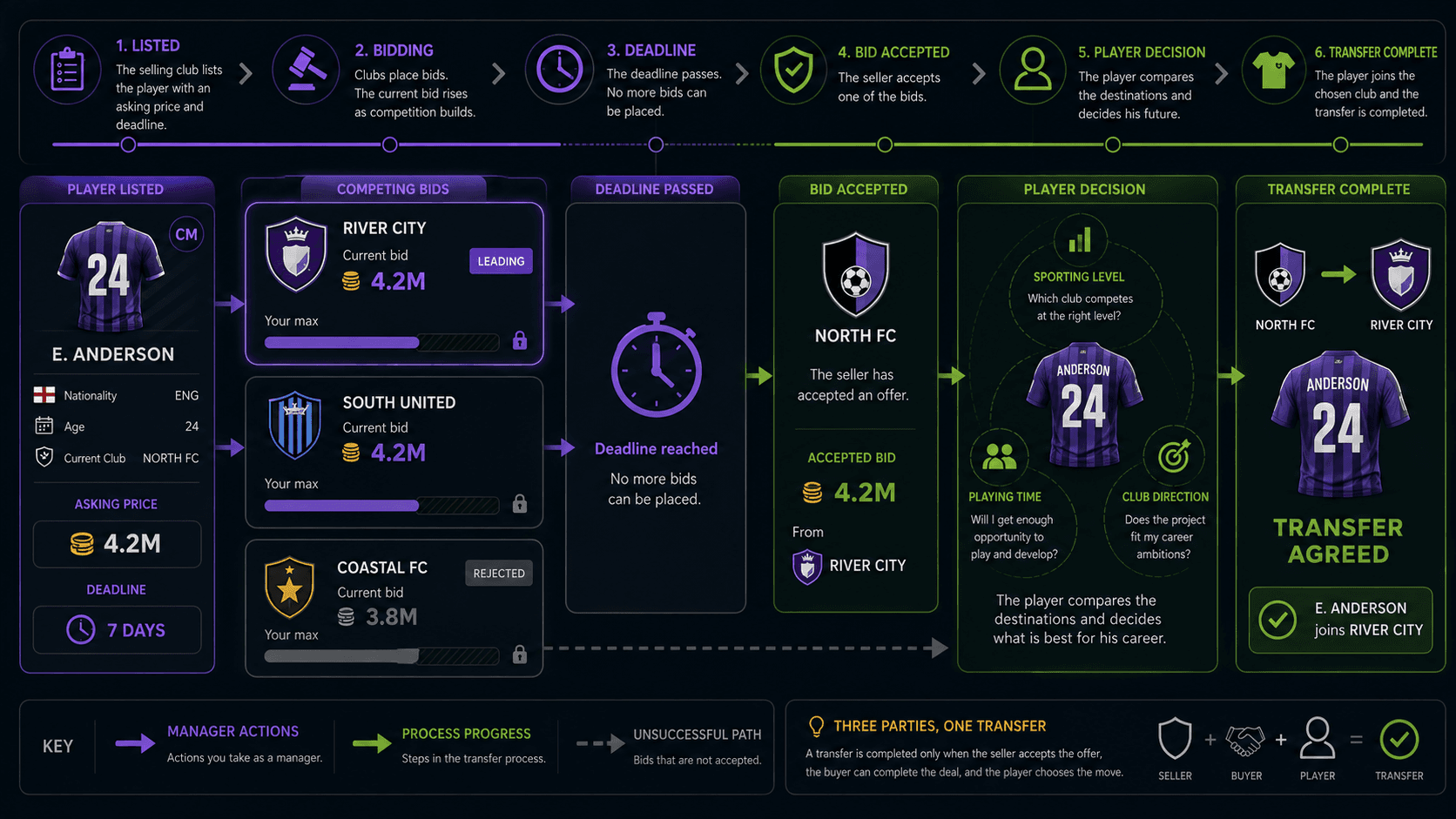
When the deal is completed, the fee changes hands, the player joins his new club and the listing closes. Other bidders are released from their commitments and can turn their attention elsewhere.
The foundations for listings, market browsing, bids, asking prices and deadlines are already represented in FTT. We are still working on the full connection between automatic bidding, budget commitments, deadline resolution, player choice and final settlement.
We would rather be clear about that than describe every visible field as a finished transfer saga.
Recruitment without an answer sheet
The transfer market should give you useful evidence without removing the need for judgement.
You can see who is available. You can compare players, scout them, follow the bidding and decide what your club can afford.
You cannot know another manager’s full plan. You cannot be certain how high the market will rise. You cannot see a player’s entire future or guarantee that he will choose your club.
That uncertainty is not something surrounding the transfer system.
It is the reason the system matters.
Good recruitment comes from understanding your squad, identifying the right profile and knowing when to commit. Sometimes it means winning a competitive bid. Sometimes it means stepping away before the price stops making sense.
And sometimes it means watching the player sign for a rival, insisting you were never that interested and immediately checking the market for alternatives.
Which part of recruitment matters most to you: finding overlooked players, competing at the deadline or convincing the right footballer that your club is his best next step?