One Shared Football World

A football club is never just a badge, a squad and eleven names on a team sheet.
It belongs somewhere.
It has a home country, a place in the national game and other clubs competing for the same players, opportunities and attention. Its history is shaped not only by what happens on the pitch, but by the football world developing around it.
For The Title is being built around that idea.
When you take control of a club, you do not enter a private football universe created only for your team. You join one shared world containing countries, competitions, clubs, players and other managers making decisions of their own.
Your club’s story belongs to you.
The world around it belongs to everyone.
A connected world for connected club stories
Every club belongs to the same wider structure, whether it is controlled by a human manager or waiting for someone to take charge. Clubs are not created in isolation whenever a new manager joins. They already have a place in the football world.
FTT begins with one shared football world. This gives your decisions a wider context.
The player you are scouting may also interest another manager. The club you face today may have someone new in the dugout next season. A team quietly developing young players in another country may eventually become one of the strongest clubs in the world.
You are building your club, but other clubs are building too.
That is where much of the long-term challenge comes from.
From the world to your club
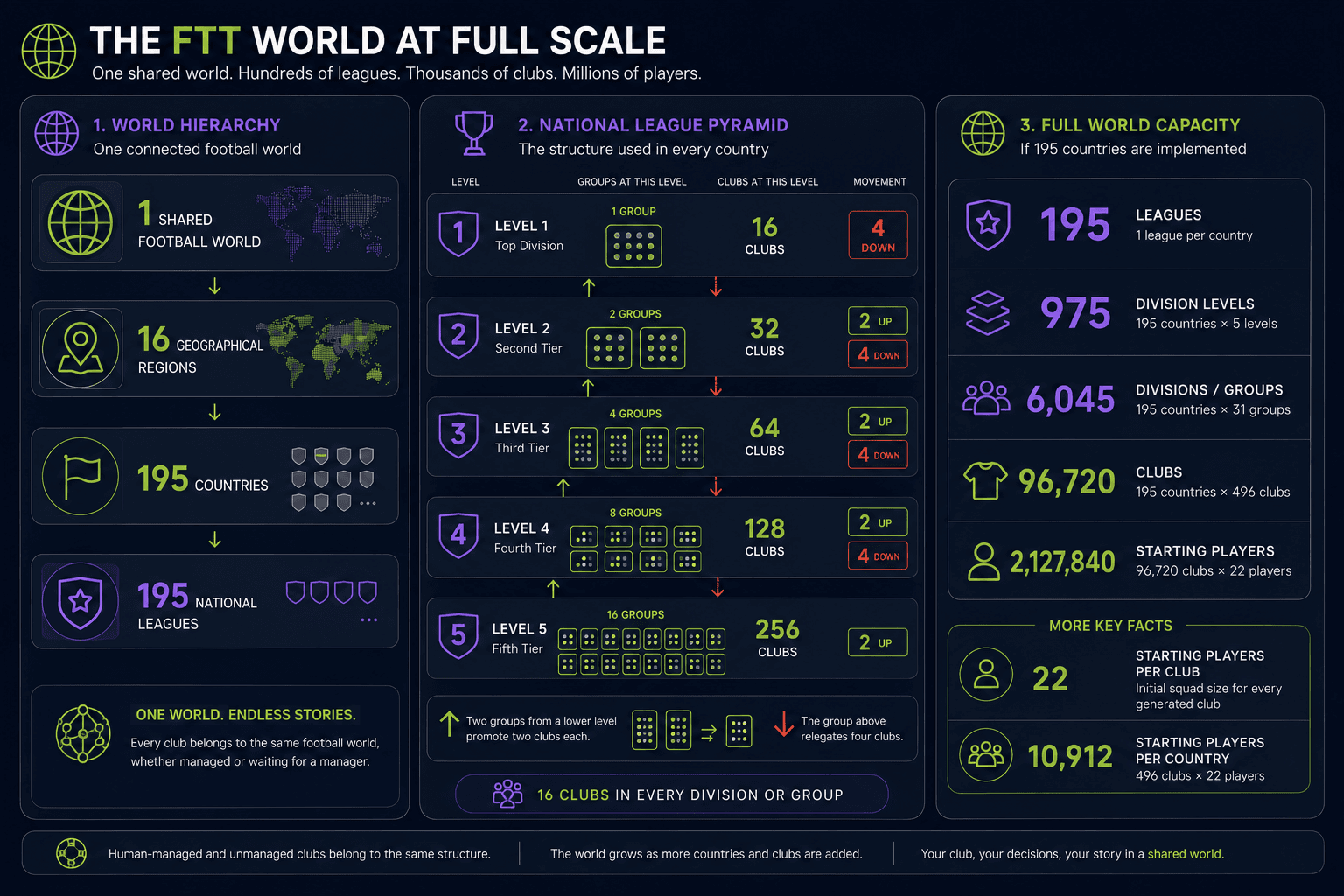
The football world is organised through a clear hierarchy:
World → Region → Country → League → Division → Group → Club
At the top is the shared world itself.
Within it are geographical regions and countries. Each country contains its own national football structure, with leagues, divisions and clubs forming the competitive path available to its teams.
At the bottom of that hierarchy is the part you will spend most of your time thinking about: your club.
The structure gives every club a clear home. It determines where the club plays, which teams surround it and how it fits into the wider football landscape.
When browsing the world, you should be able to move naturally from a region to a country, from a country to its competitions, and from those competitions to the clubs and players taking part.
There is a lot of football behind your team sheet. Most of it is also trying to beat you.
Sixteen geographical regions
The current world model contains 16 geographical regions.
These regions provide the foundation for organising countries and expanding the world over time. They allow different parts of the football landscape to have a clear place without treating every country as though it belongs in one very long alphabetical list.
The regions are not separate servers or isolated saves. Clubs still belong to the same shared world.
This gives us room to grow.
As more countries and competitions are introduced, they can be added within an existing geographical structure. The world can expand without losing the relationships that make it understandable.
The aim is not to fill every region immediately. It is to build a world that can grow in a clear and consistent way.
Starting with three countries
The initial world configuration seeds three countries, or leagues if you want:
England, Norway and Italy.
Each offers a different football setting, three different regions, but all three belong to the same world.
Choosing a club in Norway does not place you in a separate Norwegian game. Managing in England does not create a private English save. Your club remains part of the same broader football landscape as clubs in the other seeded countries.
Starting with three countries gives us a meaningful foundation while we continue developing the systems that connect clubs, competitions, players and managers.
It also gives you an immediate choice.
You may be drawn to a particular country, an available squad or simply a badge that looks like it has already survived several difficult away days.
There is no single correct starting point. The challenge is what you make of the club once you arrive.
Hundreds of clubs with somewhere to belong
A fully populated country contains 496 clubs.
Across the three initially seeded countries, the configured world can therefore contain:
1,488 clubs.
Those clubs are part of the structure whether or not a human manager has taken control of them.
A shared football world needs more than a collection of player-managed teams. It needs opponents, competitors and future destinations. It needs clubs with different situations, squads and ambitions.
Every club begins with a squad
Every newly generated club begins with 22 players.
This is the starting squad size, not an explicit maximum. Squads can change as managers recruit, sell and develop players over time.
Across a fully populated country, those starting squads account for:
10,912 players.
Across England, Norway and Italy, the full configured capacity is:
32,736 starting players.
That gives every club something to work with from the beginning. Each squad has strengths to identify, weaknesses to address and players who may suit different roles or approaches.
Some managers may inherit a balanced group that already fits how they want to play. Others may discover that half the squad prefers roughly the same part of midfield.
The first task is not to find a perfect squad.
It is to understand the one you have.
Which players can help immediately? Who still has room to develop? Where does the squad lack balance? Which areas should be strengthened first?
Those answers will differ from club to club and manager to manager.
Other managers have their own squads, priorities and problems. They may be developing players while you are trying to compete immediately. They may value a player you are willing to sell. They may see an opportunity in a club or country you overlooked.
Your decisions affect your team, but they also become part of the wider football landscape.
Recruitment becomes more meaningful when other managers are searching too. Player development matters when promising talent is valuable to more than one club. Progress feels more significant when the teams around you are also trying to improve.
Different approaches can succeed.
One manager may build patiently around young players. Another may focus on experienced recruits and immediate results. Someone else may spend several seasons creating a wonderfully balanced squad before discovering that none of the forwards are especially interested in scoring.
There is no single correct route.
The shared world gives those routes somewhere to meet.
Next: the national league pyramid
This article has focused on the world itself: how regions, countries, clubs, players and managers fit together.
The next article will look more closely at the national league structure.
We will explain how the five levels are organised, why the number of groups increases further down the pyramid, and how promotion and relegation keep clubs moving between them.
The complete fixture format and number of league matches per season are still being developed, so we will not be filling in that part of the calendar just yet.
For now, the important idea is simple.
You are not building a team in isolation.
You are taking your place in a shared football world containing thousands of players, hundreds of clubs and other managers trying to write their own stories.
We are looking forward to seeing where you take yours.