Summer 2026 Development Update
Summer is properly underway, and the World Cup has reached its final four.
That also means the For The Title team is getting ready to step away for a short summer break. Before we close the laptops and pretend we are not checking football news every ten minutes, we wanted to share where development stands.
June and July have been focused mainly on the match engine. The aim has been to make matches flow more naturally, especially in the moments where football becomes less tidy: loose balls, clearances, deflections, set pieces and players having to react when nobody has full control.
Playing into space
The first major addition was through-balls played into space rather than directly to a specific receiver.
That may sound like a small distinction, but it changes the situation completely.
Instead of always aiming for a player’s current position, the passer can target an area ahead of a run. The ball may be reached cleanly, intercepted, overhit or turned into a race between attacker, defender and goalkeeper.
To support that, we also needed stronger loose-ball mechanics.
A football match contains plenty of moments where nobody has secure possession: after a clearance, a deflection, a poor touch, a tackle or a ball played into open space. The engine now has a better foundation for handling those situations.
When the ball becomes loose, players change their movement and priorities. Some attack the ball. Some recover their shape. Others protect dangerous space or prepare for the next contest.
This was especially important for clearances and goal kicks, but it also gives the match a better recovery structure whenever control breaks down.
Building set pieces
Once those foundations were in place, we moved on to set pieces and other special situations.
Goal kicks came first. They needed their own positioning and restart flow, while also connecting properly to missed shots and balls deflected over the line.
Corners followed.
They required more specific positioning because attackers and defenders behave differently around a dead ball in the penalty area. Runs, marking, delivery zones, first contacts and second balls all need to work together before the match can return to open play.
During this work, we also introduced a better way for players to hold the ball when the team needs time to move into position.
Holding possession is not the same as doing nothing.
A player may wait for support, draw an opponent, allow a runner to move or give the team time to settle into a better shape. The important part is that holding the ball should improve the football picture. Waiting without changing anything is generally just an invitation to be tackled, which football has been demonstrating for some time.
Making carrying and progression feel more natural
With those pieces working together, we revisited progressive runs, urgency and hold-up play outside set pieces.
The goal was to make movement from the ball carrier feel more like real football across the whole pitch.
A player high up the field may attack space directly.
A defender or midfielder deeper in possession may carry forward more carefully, shift sideways to improve an angle or move backwards to reduce risk.
A player receiving between the lines may have enough room to turn and progress without immediately entering a dribble or pressing contest.
These situations matter because not every moment on the ball should become an instant pass or duel. Sometimes the player uses movement to change the situation before committing to the next action.
That creates more natural vertical progression, more realistic resets and better support for players receiving in space.
Free kicks and the next restart
After that, we added direct and indirect free kicks, including the more familiar deliveries into the penalty area.
Regular free-kick situations now have a stronger place in the wider match flow, with specialist positioning before the action returns to open play.
We have decided to postpone cards for now.
Before adding more consequences around fouls, we want to spend more time balancing the wider match across different formations, tactical shapes and player levels. Cards should connect properly to the football around them rather than exist as a separate event generator.
Throw-ins are still on the set-piece list and may be introduced later.
They are one of those features that appear simple until you remember that teams need positions, passing options, pressure, possession outcomes and the occasional full-back spending several seconds looking for anybody willing to move.
More than 2,000 matches under review
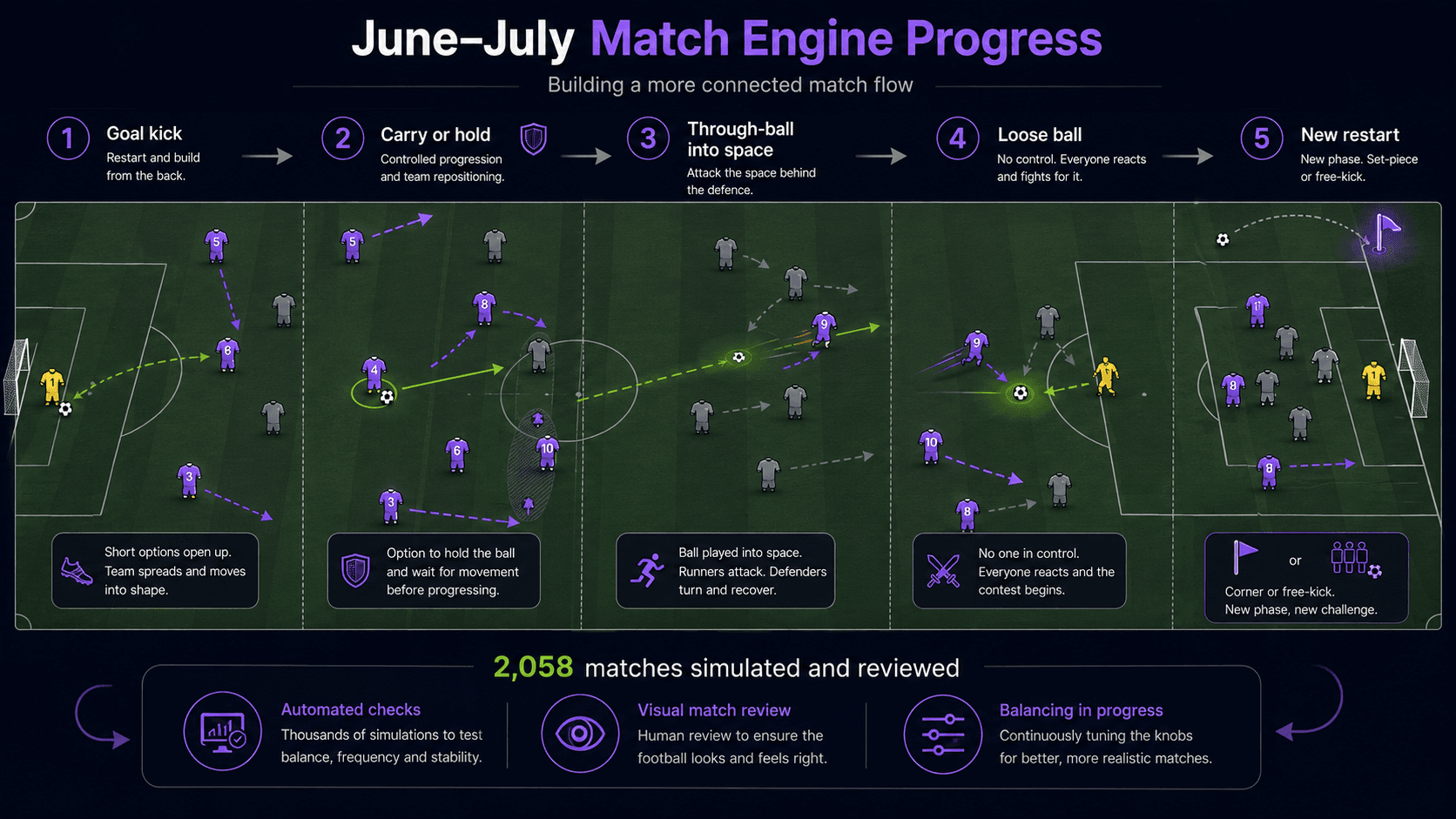
During this period, we simulated and evaluated 2,058 matches.
That work combines automated testing with visual review.
The automated side helps us identify patterns, unusual event frequencies and situations where the match stops behaving as intended. The visual side helps us judge whether the football actually flows.
Both are needed.
A sequence can be technically valid and still look wrong. A player may arrive in the correct area too late, choose an option that makes little football sense or create a chain of movement that leaves the whole shape looking strangely enthusiastic about one side of the pitch.
There are still bugs.
There are also curious decisions, frustrating moments and occasional examples of players choosing the worst available option when several unfortunate factors align.
So, in that respect, the simulation is already showing a healthy respect for football.
Expanding goal-scoring outcomes
Balancing is well underway, but there is still plenty to do after the summer.
One important area is finishing.
At the moment, the simplest shot outcomes are a goal or a save. We now have the foundations ready for more varied results, including:
- Rebounds
- Defensive clearances
- Saves behind for a corner
- Shots missing the target
These outcomes will make attacks feel less final.
A saved shot may create another chance. A block may turn into a loose ball. A defender may clear without gaining control. A miss may lead to a goal kick rather than ending as a generic failed attempt.
We may also return later to shots hitting the post or crossbar, including rebounds that create another contest.
As always, the aim is not to add events for decoration. Each outcome should create a believable next situation.
Giving managers more tactical influence
The next major area of work will be more detailed tactical control.
Formations, positions and roles already shape the match, but we want managers to have more influence over the team’s wider identity.
That includes the types of situations your team tries to create, the duels your players face and the tempo at which the match is played.
A manager may want to press high, defend deeper, play with greater intensity or control possession more patiently.
Those choices need proper trade-offs.
High pressing should not be a free advantage. It may affect player condition, defensive space, foul risk and the team’s ability to maintain the same intensity throughout the match.
A more cautious approach may protect the shape but reduce pressure on the opponent.
Tactical freedom becomes interesting when every choice gives you something and costs you something.
That work will likely be followed by substitutions and pre-planned tactical changes based on the score and match situation.
You may want the team to become more aggressive when trailing, protect central areas when leading or change shape after a certain point in the match.
Those are familiar managerial decisions, and we want them to feel connected to what is actually happening on the pitch.
Knowing when the first version is ready
There are still many ways to improve the match engine.
There probably always will be.
At some point, though, we need to decide when the first version is balanced, believable and stable enough to reconnect with the wider game.
That does not mean the match engine will be finished forever. It means it will be ready to support the next stage of For The Title.
For now, the focus remains on making movement, decisions, duels, restarts and outcomes connect into football that feels coherent from one moment to the next.
But first, it is time to close the laptop, press publish, enjoy the sun and get ready for the World Cup semi-finals.
Have a great summer.