The match engine: Twenty-Two Players, One Ball and Thousands of Decisions
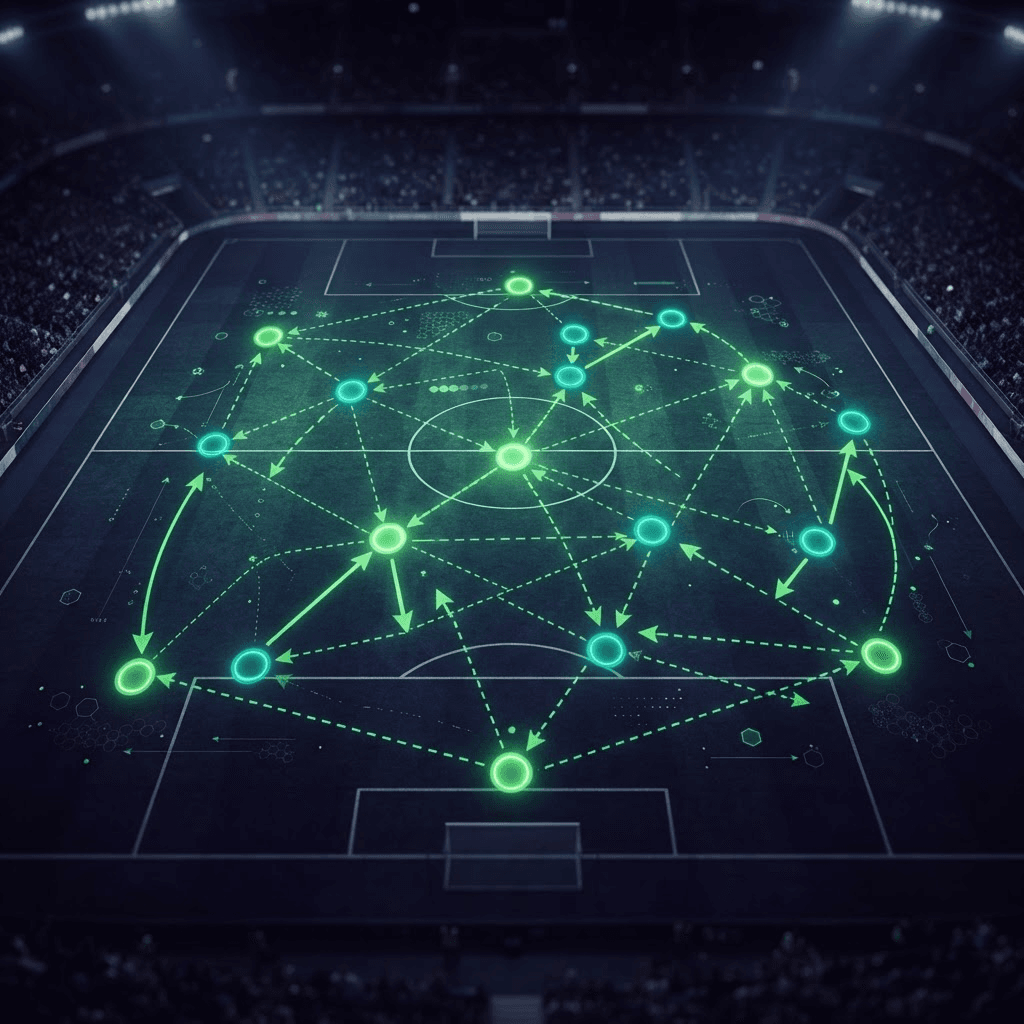
A centre-back carries the ball forward.
The midfielder ahead of him drops into space. The winger moves wider. The striker starts a run behind the defensive line.
One defender steps towards the ball. Another drops to cover. A midfielder blocks the central lane.
The centre-back now has a decision.
He can pass into midfield. He can release the winger. He can try the ball in behind. He can keep carrying. He can slow the move down and wait for the shape to improve.
Whatever he chooses, the match changes.
A pass into midfield pulls one defender forward. A wide ball shifts the entire defensive line. A through-ball creates a race. A poor touch produces a loose ball. A clearance turns an attack into a transition.
That sequence is the basic idea behind the For The Title match engine.
An FTT match is not selected from a result table and dressed up with a few convincing highlights afterwards.
It is built from the movements, decisions and contested football situations that happen between the first whistle and the last.
The match begins with a football situation
At kick-off, the engine knows the two teams, the selected players, their positions, their abilities and their starting shape.
It knows the score, the match time, the direction of attack and who has the ball.
Most importantly, it knows where all 22 players are.
From there, the match advances through a continuous series of small connected moments.
In each moment, players read the situation, move, make decisions and attempt actions. The outcome creates the starting point for whatever happens next.
A completed pass changes the ball carrier.
A turnover reverses the attacking direction.
A defender stepping out creates space behind him.
A winger moving inside may open the flank for a full-back.
A blocked shot may become a rebound rather than the end of the attack.
Football does not happen as a collection of isolated events. Neither does the FTT match engine.
All 22 players are involved
The player on the ball is the obvious focus.
He decides whether to pass, carry, dribble, shoot, hold possession or reset the attack.
But the other 21 players are also changing the situation.
An attacking midfielder may move between the lines. A winger may stretch the pitch. A striker may occupy both centre-backs without touching the ball. A full-back may overlap, creating an option that forces the defence to retreat.
Defenders are making decisions of their own.
The nearest player may press the ball. Another may cover the space behind him. A centre-back may protect the middle rather than follow an attacker into a wide area. A defensive midfielder may block a passing lane instead of attempting a tackle.
This is one of the central principles behind the engine:
Players influence the match through the space they occupy, protect and threaten—not only through touches of the ball.
A run can matter even when the pass never arrives.
A defender can stop a chance simply by standing in the right place.
A supporting player can improve an attack by giving the ball carrier one more credible option.
Formation is the starting point, not the final picture
Your formation provides structure.
It gives every player a general position and helps establish the balance of the team.
But it does not lock players onto fixed squares.
A full-back in a 4–3–3 may defend the flank, support possession, overlap the winger or recover towards the back line.
A central midfielder may drop to help the build-up, move between the lines, support the press or protect the space left by an advancing teammate.
A striker may stay high, move into a channel, drop towards midfield or press the first pass.
The same formation can therefore produce very different football depending on the players, roles and match situation.
One team may keep its full-backs cautious and build through midfield.
Another may push both full-backs forward and ask a midfielder to protect the space behind them.
The shape on the tactics screen is an anchor.
The live match shape is what happens when those anchors meet possession, pressure, movement and opposition.
Why players move
Movement in FTT is built from several football reasons acting at the same time.
A player may want to move towards his attacking position. He may also want to support the ball carrier, stay away from a nearby teammate and remain aware of an opponent threatening the space behind him.
A full-back could be pulled in several directions at once:
Forward to support the attack.
Wide to preserve the team’s width.
Inside to create a passing triangle.
Backward because the opposition winger is ready to counter.
Away from a teammate already occupying the same lane.
The final movement is the result of those competing needs.
This allows players to behave like parts of a team rather than markers following one simple instruction.
Physical ability still matters. A player may understand where he needs to go but lack the pace, acceleration or agility to arrive in time.
That difference is important.
Reading the danger and reaching the danger are not the same thing.
The player reads, chooses and executes
The player with the ball does not move directly from “option available” to “successful action”.
Several things must happen.
First, the option must exist.
Then the player must recognize it.
Then he must choose it.
Then he must execute it.
Finally, the opposition has the chance to respond.
This separation allows footballers to fail in different ways.
A midfielder may miss a run that was available.
He may see it but decide the pass is too risky.
He may choose the right pass and underhit it.
He may execute it well, only for a defender to anticipate the danger.
A player with excellent technique can still make a poor decision.
A clever player can still mistime the execution.
A good pass can still be followed by a bad first touch.
That is why one overall rating cannot explain every moment.
Football understanding, technical quality, physical execution and pressure all matter differently depending on the situation.
Duels are more than tackles
In FTT, a duel is any contested football interaction that determines the next outcome of the ball.
That includes obvious physical contests such as tackles and headers, but it also includes passes, receptions, dribbles, crosses, shots, clearances and goalkeeper actions.
A pass may contain more than one contest.
The passer must first execute the ball through the pressure around him.
Then the receiver must reach or control it.
Defenders may disrupt either stage.
A shot can work in a similar way.
The attacker must create and strike the chance despite nearby defenders. The resulting shot may then become a separate contest with the goalkeeper.
The quality of the first stage affects the second.
A rushed strike may make the goalkeeper’s job easier. A clean strike from a strong position may produce a much more difficult save.
A through-ball may not produce an immediate reception at all. It may create a race into space.
A headed clearance may remove danger without giving the defender controlled possession.
A blocked shot may become a loose ball in the penalty area.
The outcome is not simply “action succeeded” or “action failed”.
It creates the next football situation.
When nobody controls the ball
Loose balls are an important part of the engine because football is not always orderly.
A deflection, tackle, rebound, clearance or difficult reception can leave the ball without a clear owner.
When that happens, players react.
Distance matters, but so do position, role, reaction and the danger of the area.
A striker may attack a rebound.
A centre-back may step forward to clear.
A midfielder may hold his position rather than leave the centre exposed.
A winger may hesitate because the ball is loose in an area where losing the next contest would open a counterattack.
When opposing players reach the ball, the situation becomes another duel.
The winner may take control, redirect it or simply move the danger somewhere else.
These moments help create transitions, second balls and broken play—the less tidy parts of football where shape and decision-making are tested quickly.
Possession changes everything
The moment possession changes, every player’s relationship with the match changes.
The team that was spreading out to attack must recover.
The team that was compact in defence suddenly needs passing options and forward movement.
A full-back who was supporting the attack may now have to sprint back.
A winger who had been defending deep may become the first outlet.
A midfielder who was arriving near the penalty area may need to protect the centre.
That reversal creates one of the most important feedback loops in the engine:
Position and possession lead to decisions. Decisions create movement and actions. Actions create outcomes. Outcomes create new positions, space and possession. Then the next decision begins.
A single turnover can reshape the whole pitch.
Match context changes behaviour
Players should not move with the same urgency in every situation.
The score matters.
The match phase matters.
The location of the ball matters.
A team chasing the game may take more risks. A team protecting a lead may value shape and security. A defender recovering towards his own goal has a different priority from one stepping forward during settled possession.
A loose ball near the halfway line is not the same situation as a loose ball inside the six-yard box.
The engine uses the live match context to influence how players behave.
The exact internal calculations remain part of the engine, but the football principle is visible:
The same player may make a different decision because the situation around him is different.
Restarts temporarily change the rules
Kick-offs, goal kicks, corners, free kicks and penalties create their own temporary phases.
The engine must establish where the ball belongs, who takes the restart and where attackers and defenders should move.
Players take up roles suited to the situation before the action begins.
A corner does not use the same positioning logic as open play.
A goal kick changes the starting shape of the build-up.
A free kick may create runners, blockers, marking responsibilities and second-ball positions.
Once the restart is completed, the match returns to open play and the usual movement, decisions and duels continue.
These areas are still being refined, but they follow the same broad principle as the rest of the engine: football situations should create football behaviour.
Why two matches never unfold in exactly the same way
Two teams can use the same formations and still produce very different matches.
Their players have different qualities.
Their roles create different movements.
One defender steps out while another drops.
One winger stays wide while another attacks the half-space.
One midfielder sees the forward pass while another recycles possession.
An early duel changes where the next action begins.
A loose ball falls into a different area.
A goal changes the urgency of both teams.
There is uncertainty, but the engine is not trying to create difference for its own sake.
The uncertainty comes from imperfect players making decisions in changing situations under pressure.
That is football.
Giving managers evidence
Because the engine builds the match moment by moment, it can support much more than the final score.
It can capture player movement, ball movement, possession changes, passes, duels, shots, blocks, saves, clearances and set-piece phases.
That creates opportunities for useful match analysis.
Where did attacks develop?
Which players found space?
Did the team create width?
Was the midfield crowded?
Which defender stepped out?
Where did turnovers happen?
Did a striker receive support, or spend the match isolated?
The aim is to give you evidence from your own matches without publishing the hidden calculations that decide every action.
Statistics and visualizations should explain what happened.
They should not provide a guaranteed recipe for what will happen next.
What we are still refining
The core foundations of the FTT match engine are already substantial.
The match advances moment by moment. Players and the ball move. Possession changes. Players pass, carry, shoot, press, cover and compete. Loose balls and restarts create different phases. Events and statistics are captured throughout.
We are still calibrating movement, event frequency and tactical behaviour.
Some parts of the model are more mature than others. Certain tactical forces, match-management features and wider integrations still need more work.
We would rather show the direction honestly than pretend every football situation is already final.
The goal is not simply to create more events.
It is to make the events connect in a way that feels like a match.
From formation to final whistle
FTT does not try to predict football from one team rating.
It builds the match from the decisions, movements and contests that create football in the first place.
Your formation provides the structure.
Your players interpret the situation.
Their abilities shape what they can see and execute.
The opposition creates pressure.
Every action changes the next problem.
Twenty-two players. One ball. Thousands of connected decisions.
That is where the match begins.