Welcome to the For The Title Devlog

For The Title is a browser-based multiplayer football manager game about building a club, developing a team and making the decisions that shape what happens on the pitch.
This devlog is where we will share the journey of creating it.
You can learn more about the game and register your interest at forthetitle.com.
What is For The Title?
For The Title puts you in charge of a football club competing against other human managers.
You will build your squad, develop players, choose how your team should play and make the decisions that move the club forward. The aim is not only to select a starting eleven, but to create a team with its own identity.
That includes decisions such as:
- Which players to sign and sell
- How to balance the squad
- Which formation and tactical approach to use
- Create a playstyle and club identity
- How to develop talents
- How to balance and train your squad
The ambition is for you to understand why your team performs the way it does—not simply receive a result at the end of a match.
A football world shared with other managers
For The Title belongs to the tradition of persistent, browser-based multiplayer football manager games.
These games are different from traditional single-player football management games. You are not competing against computer-controlled clubs that disappear when you close the game. You are taking part in an ongoing football world shared with other people.
Other managers are developing their squads, searching for players, preparing tactics and competing for the same achievements.
The world continues from season to season. Players develop and decline. Clubs rise and fall. Rivalries emerge. Decisions made today can shape a team for a long time.
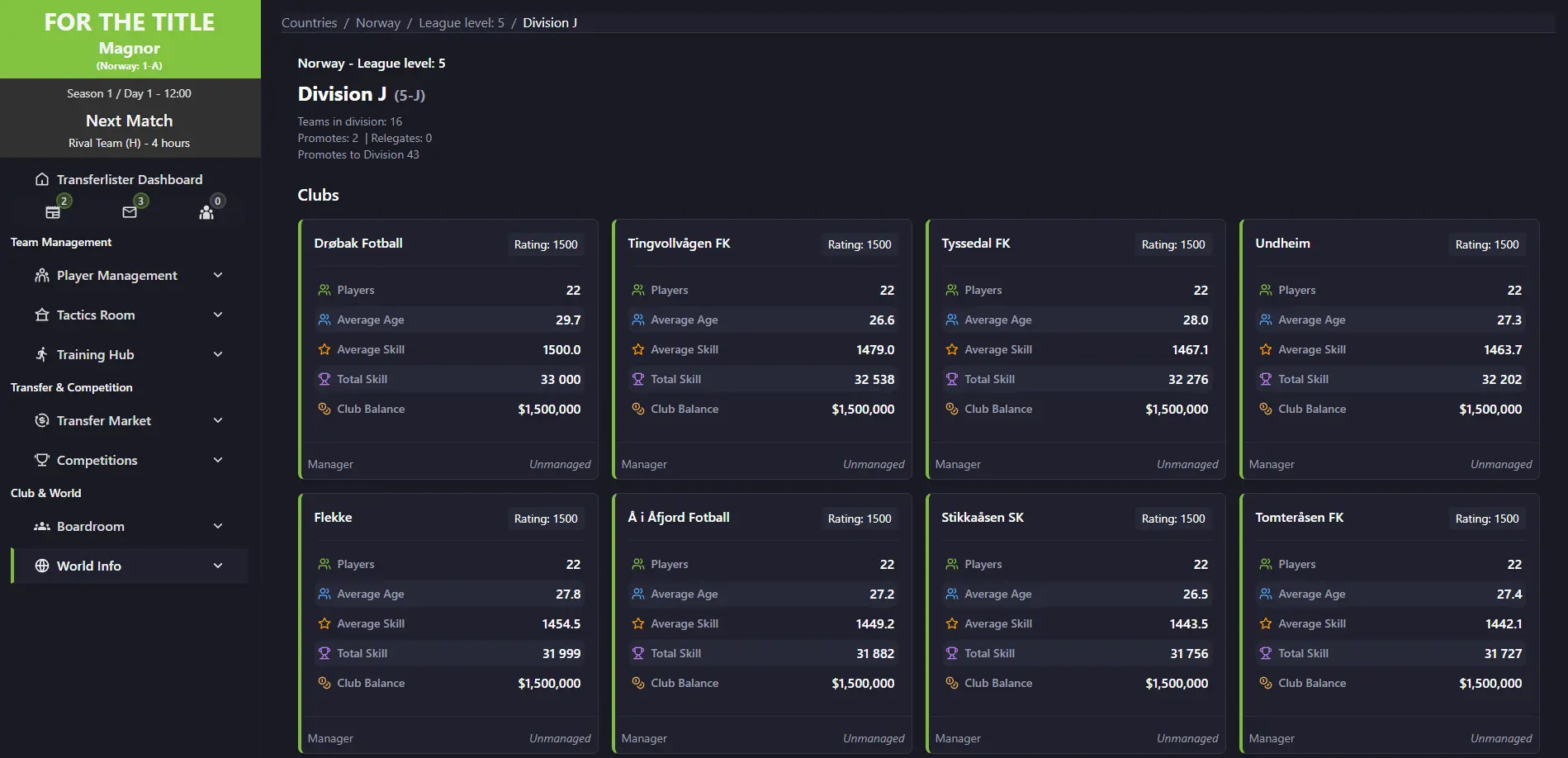
For The Title aims to combine the long-term competition and community of classic browser-based manager games with a more modern interface, deeper tactical systems, advanced game engine and greater visibility into what is happening behind the result.
The major parts of the game
The game is built around a number of connected areas.
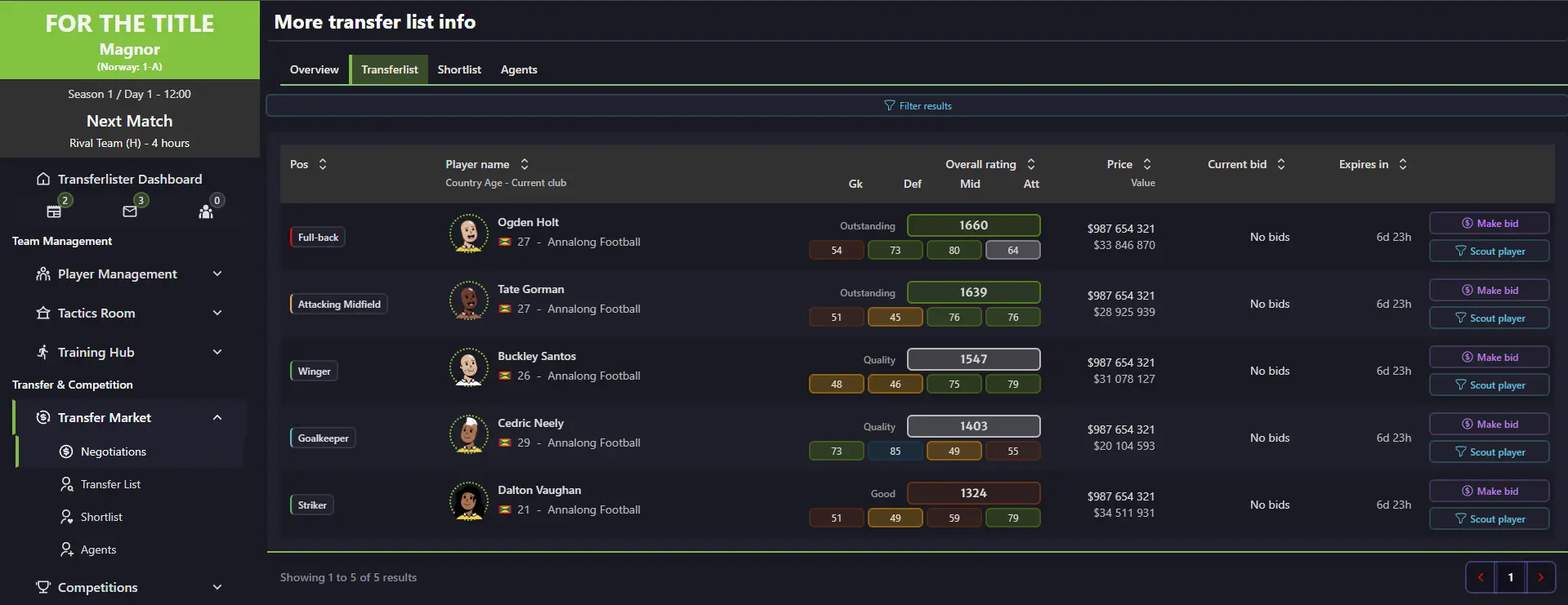
Building your squad
Every club needs a balanced group of players.
A talented player may still be the wrong fit for your system. A young player may require time before becoming useful. An experienced player may solve an immediate problem but provide little long-term value.
Squad building is therefore about more than collecting the players with the highest numbers. It is about identifying what your team needs and making choices within the resources available to you.
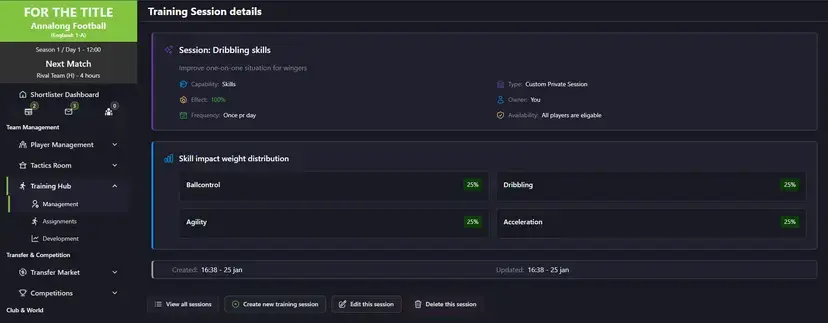
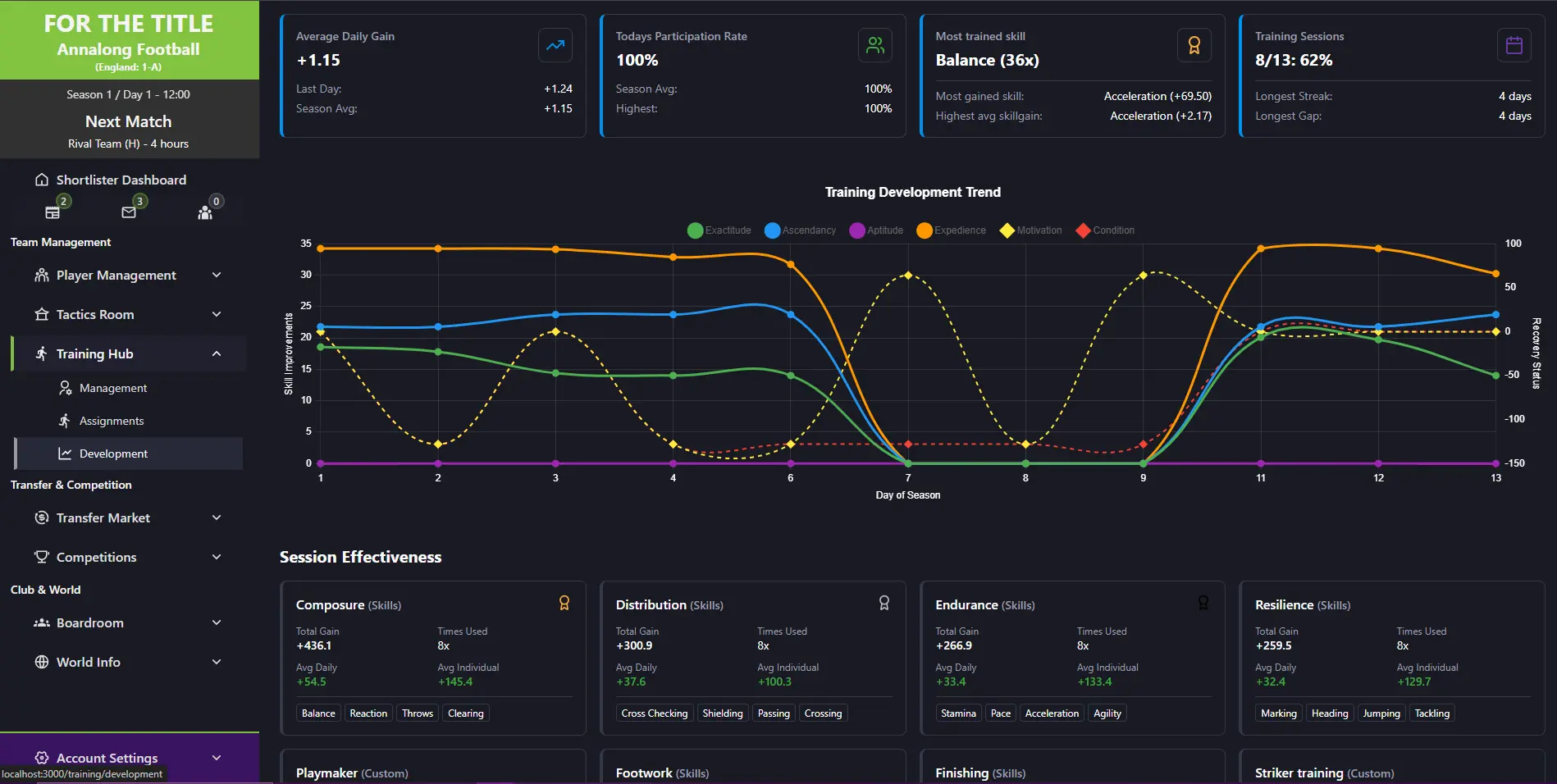
Developing players
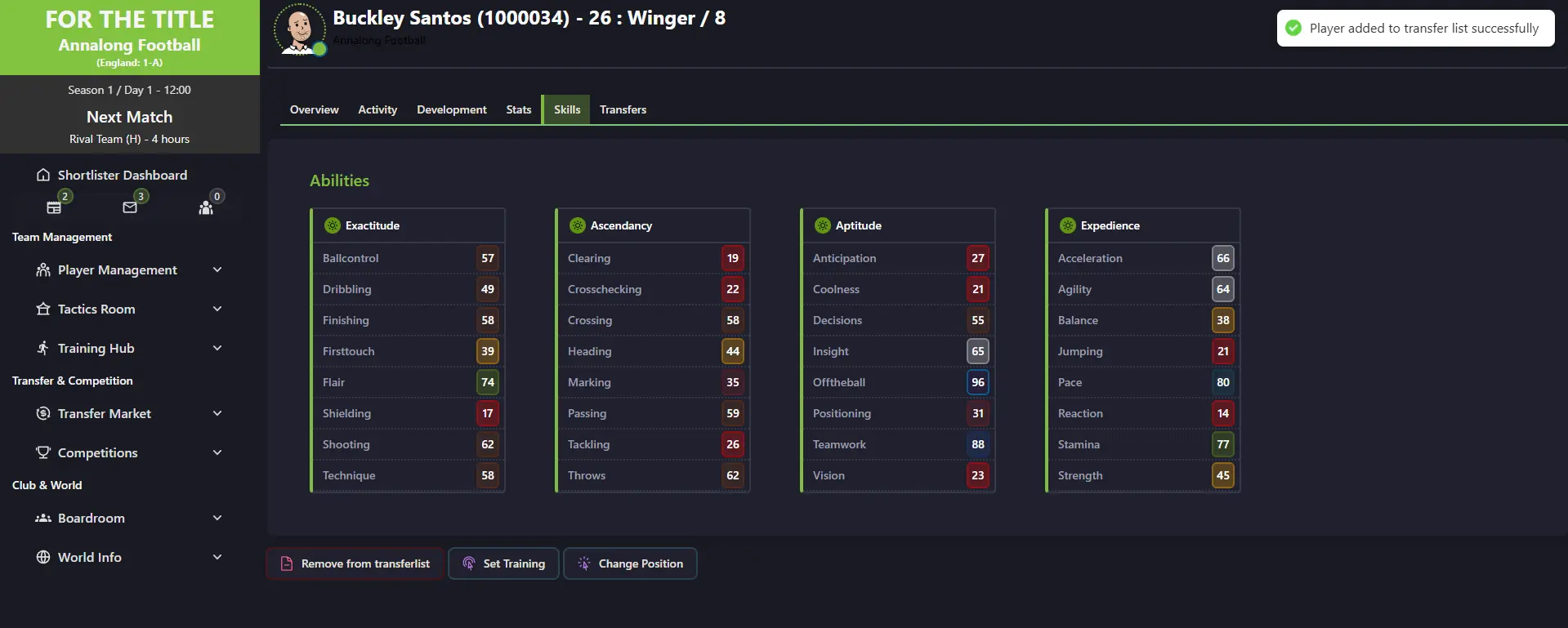
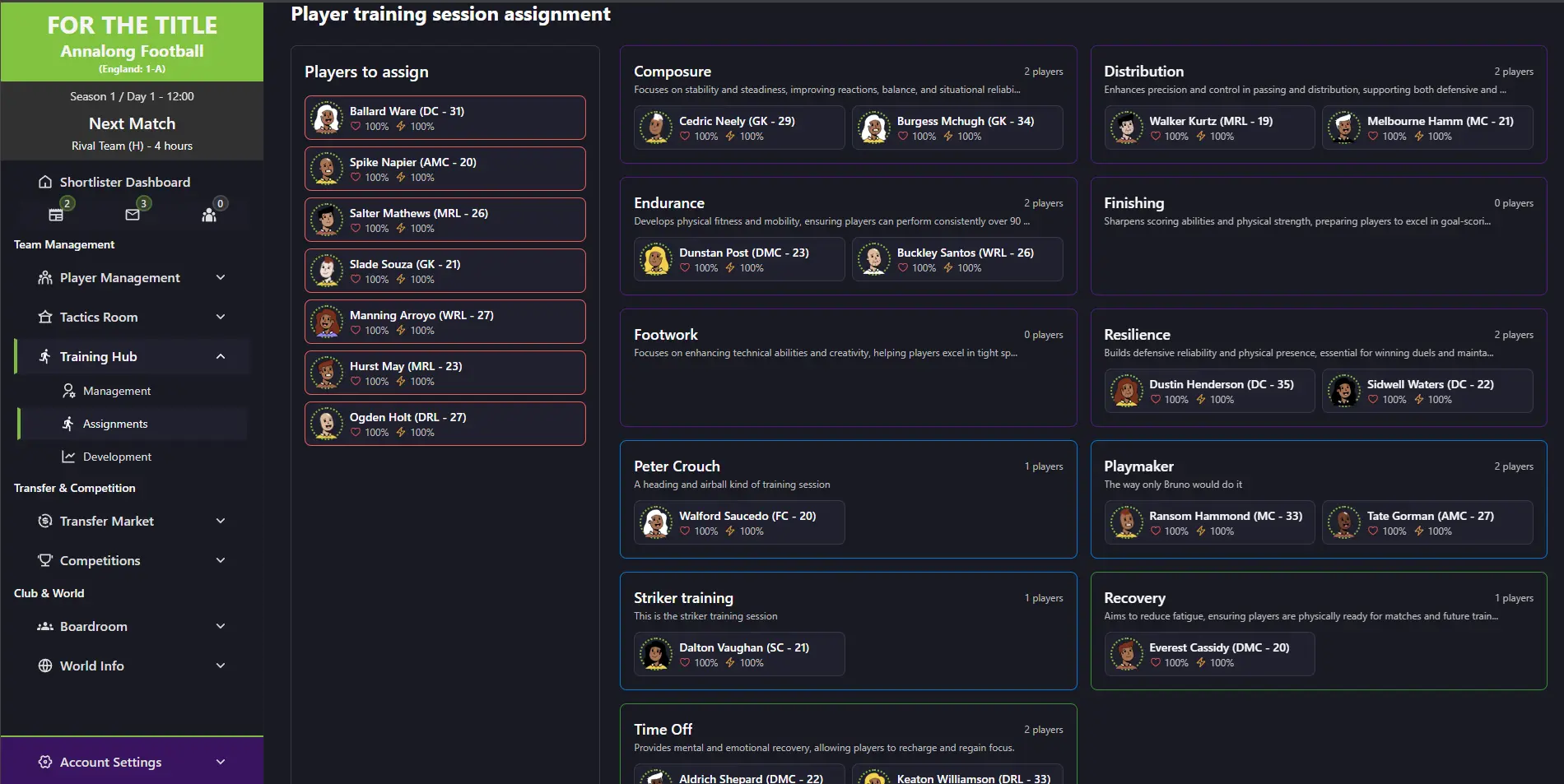
Players are not static.
Their abilities, experience, form and suitability for different responsibilities can change over time. Managers must decide where to invest their attention and how to create opportunities for players to improve.
Development should involve meaningful trade-offs. Focusing on one part of a player’s game may mean giving less attention to another.
Creating a tactical identity
Your formation is only the starting point.
Players will have roles, responsibilities and instructions that influence how they position themselves and what decisions they make. The same formation can behave very differently depending on the players and instructions used within it.
A team might try to dominate possession, attack quickly, defend deeply, press aggressively or target a particular weakness in the opponent.
The goal is to let managers create recognisable styles rather than choose between a small set of fixed tactical presets.
Watching matches unfold
The match engine simulates the positioning, movement, decisions and duels that take place during a football match and provide deep statistical analysis on a team and player basis.
Players attempt passes, make runs, challenge for the ball, take shots and react to what is happening around them. Their decisions are influenced by their abilities, instructions, teammates, opponents and the current match situation.
The match presentation will help managers see how players perform, what they do well and what they do poorly.
A result should not feel like an unexplained calculation. You should be able to look at the match and identify patterns:
- Where your team created space
- Why attacks broke down
- Which players were repeatedly involved
- Where the opponent caused problems
- Whether your tactical choices had the intended effect
Competing over time
Individual matches matter, but the game is designed around the longer story of a club.
A successful season may be followed by the challenge of replacing important players. A rebuilding team may need patience before it can compete. A tactical idea that works today may need to evolve as opponents adapt.
The most interesting decisions are often those where there is no obvious perfect answer.
Why this devlog exists
The For The Title Devlog will be the main place for development updates, previews and explanations of how the game works.
Some posts will present visible features, such as:
- Squad management
- Player profiles
- Tactics
- Training and development
- Transfers
- Competitions
- Match presentation
Other posts will go deeper into the systems behind them.
We will look at subjects such as:
- How players make decisions during matches
- How positioning and movement mechanics work
- How tactical instructions affect behaviour
- How different player abilities interact
- How chances are created
- How duels are resolved
- How player development is balanced
- How the football world changes over multiple seasons
The intention is not only to announce that a feature exists. We want to explain what the features are trying to achieve, why it has been designed in a particular way and which questions still need to be answered, and how it might improve.
Building the game in the open
This devlog will also be a place to share ideas before every detail is finalized and implemented.
Game systems often improve when they are discussed with the people who will eventually use them. A mechanic that looks correct on paper may be difficult to understand in practice. A realistic system may not always create an enjoyable decision. A simple idea may become much more interesting when viewed from another perspective.
We therefore want to use the devlog to:
- Present ideas and early designs
- Explain the reasoning behind important decisions
- Show screenshots and prototypes
- Visualise systems that would otherwise be difficult to understand
- Discuss alternatives and trade-offs
- Gather reactions from future players
- Refine features before they are considered complete
Not every idea presented here will appear in exactly the same form in the finished game. Some will change as they are tested. Others may be simplified, expanded or replaced entirely.
That is part of the purpose of sharing the process. Not all details will be transparent, but we will aim at football realism in the match engine and the game itself. But the core mantra of the game is that we want it to be fun. So we will sacrifice realism if it isnt fun. This is why injuries will not be implemented for example. Injuries simply arent fun.
More than a list of features
Football management games are made from many interconnected systems.
A transfer system affects squad development. Squad development affects tactical possibilities. Tactical choices affect the match engine. Match results affect finances, expectations and long-term planning.
Because of this, individual features cannot always be understood in isolation.
The devlog will provide the background needed to see how these systems connect. Over time, it should become both a record of the game’s development and a guide to the ideas behind For The Title.
Follow the journey
For The Title is still being built, and there is much more to present.
Future posts will take a closer look at the game’s major systems, starting with the foundations of managing a club and the way football is simulated on the pitch.
Visit forthetitle.com to learn more about the game and register for future testing opportunities.
Welcome to the devlog—and welcome to For The Title.